


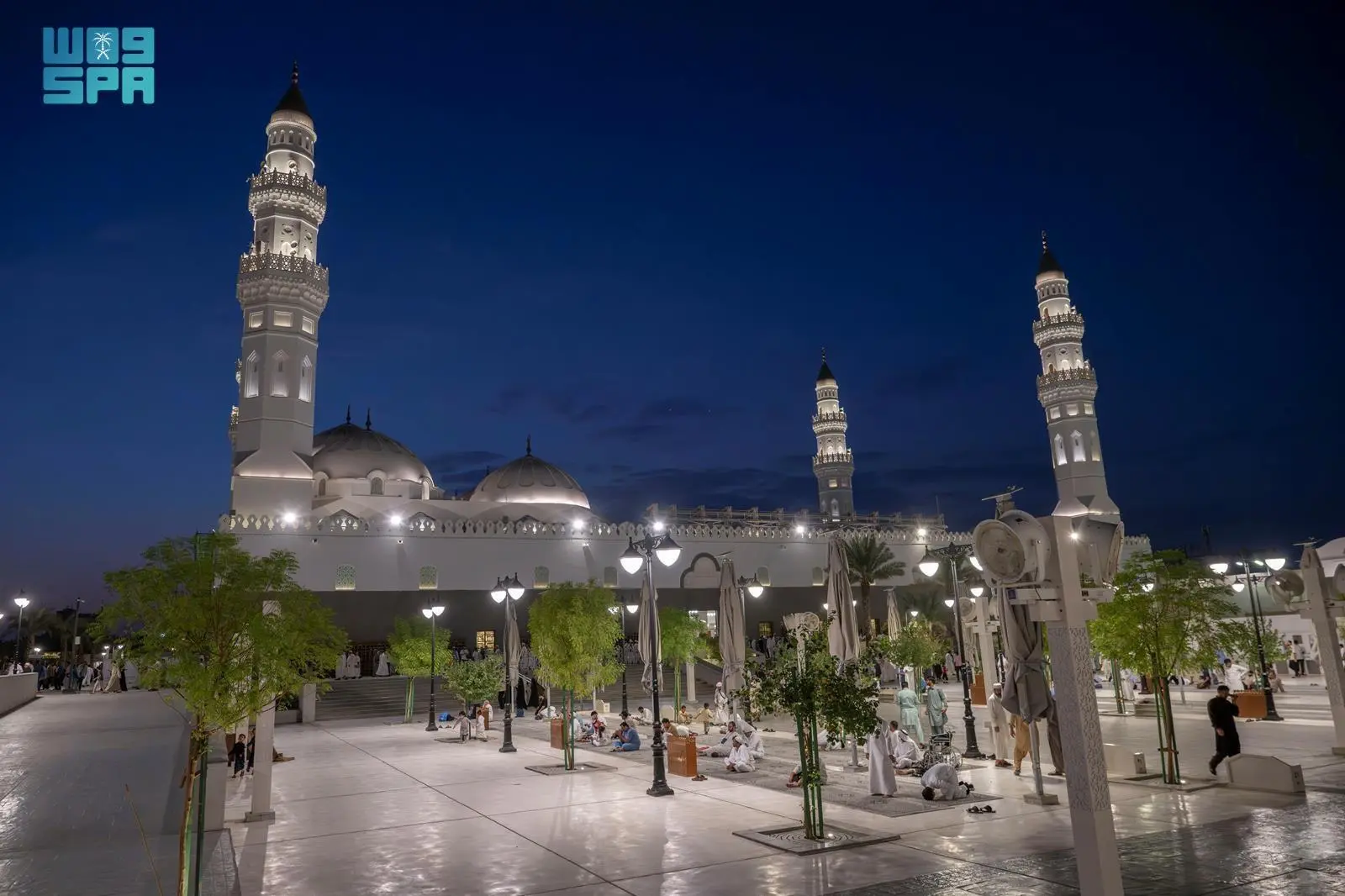
Twenty-six million people visited Quba Mosque last year. The figure, released by the Saudi Press Agency in January, places the mosque among the most visited religious sites in the world. It is also, by centuries, one of the oldest mosques still in use anywhere. Quba was the first mosque built in Islam, its foundations laid by the Prophet Muhammad in the year 622 CE, and it has been in continuous religious use ever since.
Today it sits 3.5 kilometres southwest of the Prophet’s Mosque in Madinah, along Hijra Road. It is undergoing the largest expansion project in its history.
A Mosque That Predates the Islamic Calendar
The story of Quba begins with the Hijra, the Prophet Muhammad’s migration from Mecca to Medina in 622 CE, the event that marks year one of the Islamic calendar. According to the traditional account, on his journey he paused at the village of Quba, just outside the city then known as Yathrib. His she-camel is said to have knelt at a well belonging to a companion named Abu Ayyub al-Ansari. The Prophet stayed there for fourteen nights, waiting for Ali ibn Abi Talib to arrive from Mecca. During that period, he began the construction of a mosque on the spot, laying the first stones himself.
The site had been inhabited by the tribe of Bani Amr ibn Auf, and the mosque was originally known as Bani Auf Mosque. It took its later name from the Quba well around which the village had grown. In the years that followed, as Islam spread, the mosque acquired a specific religious status. A well-known Hadith records the Prophet saying that a prayer performed at Quba carries the reward of an Umrah, the shorter pilgrimage to Mecca. That single tradition, passed down through generations of Muslim scholarship, is one of the reasons the mosque draws the volume of visitors it does today.
Islamic tradition places Quba as one of the most spiritually significant sites in the faith after the three holy mosques of Mecca, Medina, and Jerusalem. The Prophet is recorded as having visited it regularly during his years in Medina, and he particularly encouraged prayer there on Saturdays, a practice that many pilgrims still observe.
Fourteen Centuries of Reconstruction
Almost nothing of the original 622 CE structure survives. The mosque has been rebuilt many times over its history under successive Islamic rulers, from the Rashidun caliphs through the Umayyad and Abbasid eras, the Ottomans, and finally the Saudi state. Each reconstruction has expanded and modernised the mosque while preserving its location and religious function. Yaqut al-Hamawi, the thirteenth-century geographer, described its history in his Mu’jam al-Buldan, and the mosque he wrote about was already several centuries removed from the one the Prophet built.
The current mosque covers roughly 5,000 square metres of prayer space, with total site area of around 13,500 square metres including its courtyards. It can accommodate approximately 22,000 worshippers, a capacity that has been comfortably exceeded during major religious seasons. In Ramadan and around the Hajj period, the crowds surrounding the mosque routinely spill into the streets beyond.
The features of the mosque today reflect its status as an active religious site rather than a museum. Its courtyards contain more than 8,000 square metres of new carpets. Its Zamzam water storage capacity is 98,000 litres. It has 1,500 upgraded lighting and visual identity units, and around-the-clock transportation services running for elderly worshippers and pilgrims with disabilities. These are the practical accommodations required to receive 26 million people annually.
The King Salman Project
The mosque is now in the middle of the most substantial physical transformation it has undergone since its construction. On April 8, 2022, Crown Prince Mohammed bin Salman visited Quba to launch what has been officially designated the King Salman Project to Expand Quba Mosque and Develop the Surrounding Area.
The scale of the project is significant. The mosque’s total area will be expanded to 50,000 square metres, roughly ten times its current footprint. Its worshipper capacity will grow from 22,000 to approximately 66,000. On completion, Quba will become the third largest mosque in Saudi Arabia by capacity, after the Grand Mosque in Mecca and the Prophet’s Mosque in Madinah. The project connects the existing mosque with shaded courtyards on all four sides, functionally and visually linking new independent prayer halls to the historic structure without altering the original building itself.
Beyond the mosque itself, the project also includes the restoration and development of 57 historical sites in the surrounding area, including wells, farms, and orchards that date to the Prophetic era. Three of the historical routes associated with the Prophet’s activities in Medina are being formally linked and interpreted as part of the same development.
The project falls within the Pilgrim Experience and Quality of Life programmes under Vision 2030. Its stated purpose is not tourism in the conventional sense. It is to accommodate the growing number of Muslims travelling to Madinah for religious visitation, and to preserve the surrounding historical landscape as part of that experience. The distinction matters. Quba is not being repositioned as a tourist attraction. It is being expanded to receive a growing volume of pilgrims and worshippers who already come to it for reasons that have not changed in fourteen centuries.
What the 26 Million Figure Actually Represents
The visitor number released in January is a useful measure of scale, but it needs some contextualising. The 26 million figure includes worshippers who prayed at the mosque, pilgrims who visited during their journeys to and from the Prophet’s Mosque, and residents of Madinah for whom the mosque is a regular part of religious life. It is not comparable to tourism figures at secular sites in the conventional sense. Quba is a working religious site whose primary function has never changed.
That said, the number tells a real story about the growing scale of Umrah and religious visitation to Saudi Arabia. Under Vision 2030, the Kingdom has set ambitious targets for expanding Umrah capacity and streamlining the pilgrim experience. The introduction of the electronic Umrah visa, the extension of visa validity, the digitisation of the pilgrimage experience through the Nusuk platform, and the physical infrastructure investment across both Mecca and Madinah have collectively increased the number of foreign Muslims able to visit the holy cities. Quba, sitting a short drive from the Prophet’s Mosque and holding its own distinct religious status, has benefited directly from that expansion.
For Muslims visiting Madinah, Quba is typically a required stop rather than an optional one. Many make a point of visiting the mosque on a Saturday, in keeping with the Prophetic tradition. Others visit early in the morning, when the crowds are lighter and the marble underfoot is still cool. During Ramadan, the mosque draws its largest crowds of the year, and the surrounding roads become impassable for hours around each prayer time.
A Fourteen-Century Institution, Still Growing
Quba Mosque is, in its physical form, almost entirely modern. The stones the Prophet is said to have laid in 622 CE dissolved into the earth long ago. The mud-brick walls of the earliest structure have been rebuilt many times. What remains constant is the location, the tradition, and the religious status the site has held continuously since the year the Islamic calendar began.
When the King Salman expansion is complete, the mosque will look different again. It will accommodate three times as many worshippers as it does today. It will sit at the centre of a developed historical district that formally connects it to other Prophetic sites in Medina. Its 26 million annual visitors will find themselves in a substantially larger building, with substantially better infrastructure, standing on the same ground the Prophet chose fourteen centuries ago.
For a mosque that has been rebuilt in every major era of Islamic history, this is a continuation of that history.
Comments (0)