


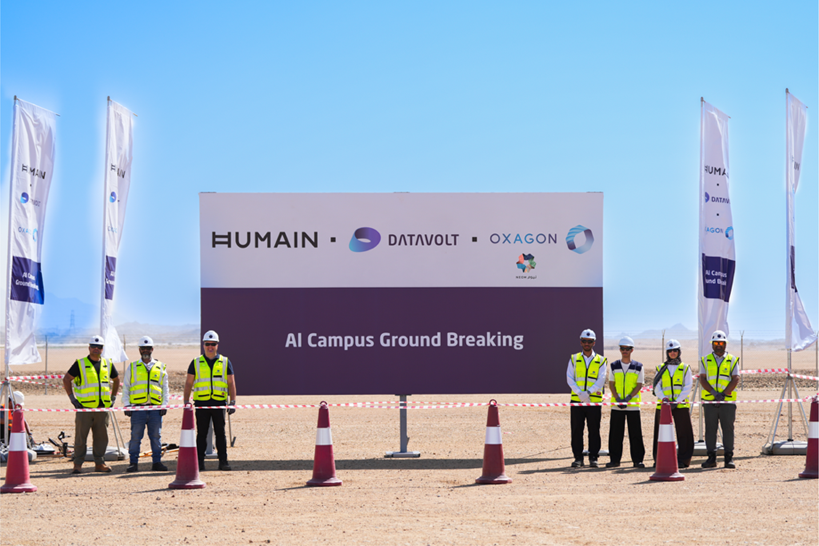
On Monday, at the opening of LEAP in Riyadh, HUMAIN and DataVolt announced they had broken ground on a 100-megawatt AI data centre at Oxagon, the industrial city on NEOM’s Red Sea coast.
The first 100MW of capacity is expected to be available in 2028. The two companies described the announcement as an expanded partnership.
The 100MW is the first physically delivered piece of a much larger project. When DataVolt and NEOM first signed their agreement at LEAP 2025, the joint plan was for a $5 billion, 1.5-gigawatt AI data centre campus at Oxagon, to be built out in phases and powered entirely by renewable energy. The current phase, now formally under construction, is a 360MW first tranche. HUMAIN’s involvement covers 100MW of that tranche.
What HUMAIN Just Bought Into
HUMAIN is a PIF-owned company delivering full-stack AI capabilities, with a stated ambition of building every layer of the AI value chain from foundation models to consumer devices. Until now, most of that build-out has been in software, model development, and partnership-based hardware. The DataVolt announcement takes HUMAIN into the physical infrastructure layer directly, with a co-developed 100MW share of an operating AI data centre.
The distinction matters for what HUMAIN is trying to be: a company that runs its models on someone else’s data centres depends on that provider for pricing, capacity, and configuration. A company that co-owns its data centres controls all three. HUMAIN’s public positioning has repeatedly emphasised its intention to compete on speed of deployment and cost of delivery, both of which are much easier to control from an owned facility than from a leased one.
Tareq Amin, HUMAIN’s chief executive, framed the deal in delivery terms in the joint statement. “AI ambition only matters when you can turn it into infrastructure, compute and capacity that customers can use. Construction is underway, 100MW is moving forward, and we are building with the speed and scale that the next era of AI demands.”
Who DataVolt Is
DataVolt was founded in 2023 as a wholly owned subsidiary of Vision Invest, a Saudi development and investment holding company focused on critical infrastructure. It is headquartered in Riyadh, with offices in the United States, Uzbekistan, India, and the UAE. Its founding thesis, as CEO Rajit Nanda has described it publicly, is that energy availability, rather than capital or computing hardware, is the real bottleneck of the AI era, and that data centres should be built where the power exists rather than where it does not.
Saudi Arabia, in DataVolt’s calculus, is one of the more attractive AI infrastructure locations globally on that criterion. It has abundant land, a rapidly expanding renewable energy sector, existing subsea cable connectivity to three continents, and a state apparatus willing to fast-track large infrastructure projects. The Oxagon campus is DataVolt’s flagship project. Additional developments are planned in Uzbekistan and elsewhere in Central Asia.
Why Oxagon Specifically
Oxagon sits at the southwestern corner of NEOM, on the Red Sea coast. The Saudi government has been marketing it since 2021 as the world’s largest floating industrial city, though the current build-out is primarily land-based. It has been designed from the outset as an integrated industrial ecosystem, combining pre-zoned land, dedicated port infrastructure, and access to NEOM’s wind and solar generation capacity.
For AI infrastructure, three of Oxagon’s characteristics matter more than the others. Its Red Sea location gives it direct access to subsea fibre-optic cables running between Europe, Africa, and Asia. Its power sourcing is designed to be predominantly renewable, which addresses the increasingly serious carbon accounting problem that AI infrastructure has begun to create for hyperscale operators. And its planning environment allows large industrial developments to be approved and built at a pace that most jurisdictions cannot match.
Aiman Al-Mudaifer, the managing director and chief executive of NEOM, described the ecosystem as taking shape in his own comments on the groundbreaking. “The ability to secure the power, land and connectivity needed to grow is becoming critical to the economics of AI. As progress on the first phase of DataVolt’s AI campus accelerates, Oxagon is bringing these advantages together to create a strong proposition for companies building the infrastructure required for the next generation of AI.”
The Broader Picture
The AI infrastructure market is defined by an acute imbalance between demand and available capacity. The International Energy Agency has estimated that data centres consume between 1 and 1.3 percent of global electricity today, a figure that is expected to rise significantly through the 2020s and 2030s as AI workloads scale. Hyperscale providers in the United States, Ireland, and parts of Asia are running into planning restrictions, grid capacity constraints, and community opposition to new development. Every new gigawatt of AI-ready capacity that comes online outside those constrained geographies has strategic value.
Saudi Arabia is positioning itself to supply a meaningful share of that new capacity for the region between Europe and Asia. The HUMAIN-DataVolt joint development at Oxagon is one part of a broader Saudi build-out that includes HUMAIN Core, the company’s own data centre programme aimed at up to six gigawatts of eventual capacity, and separate infrastructure investments across the Public Investment Fund’s technology portfolio.
The 100MW being built now is the first physically operational piece of this capacity to move from announcement into construction. The 360MW first phase around it is scheduled to follow. The 1.5GW total campus, if it is completed as planned, would be one of the largest single AI infrastructure sites anywhere.
The 2028 delivery date is the one to watch. Data centre projects, like most large infrastructure, are announced regularly and delivered less regularly.
Whether the 100MW comes online on schedule will be the first practical test of whether Saudi Arabia’s AI infrastructure ambition is being executed at the speed its architects are describing.
Comments (0)