
There is something quietly audacious about building the Middle East’s largest water park in one of the world’s most arid countries.
Saudi Arabia receives an average of roughly 100 millimetres of rainfall a year. Large parts of the country go years without meaningful precipitation. The peninsula’s relationship with water has always been defined by scarcity, by the reverence afforded a desert wellspring, by the cultural weight of an oasis, by the particular joy of rain in a place that rarely sees it.
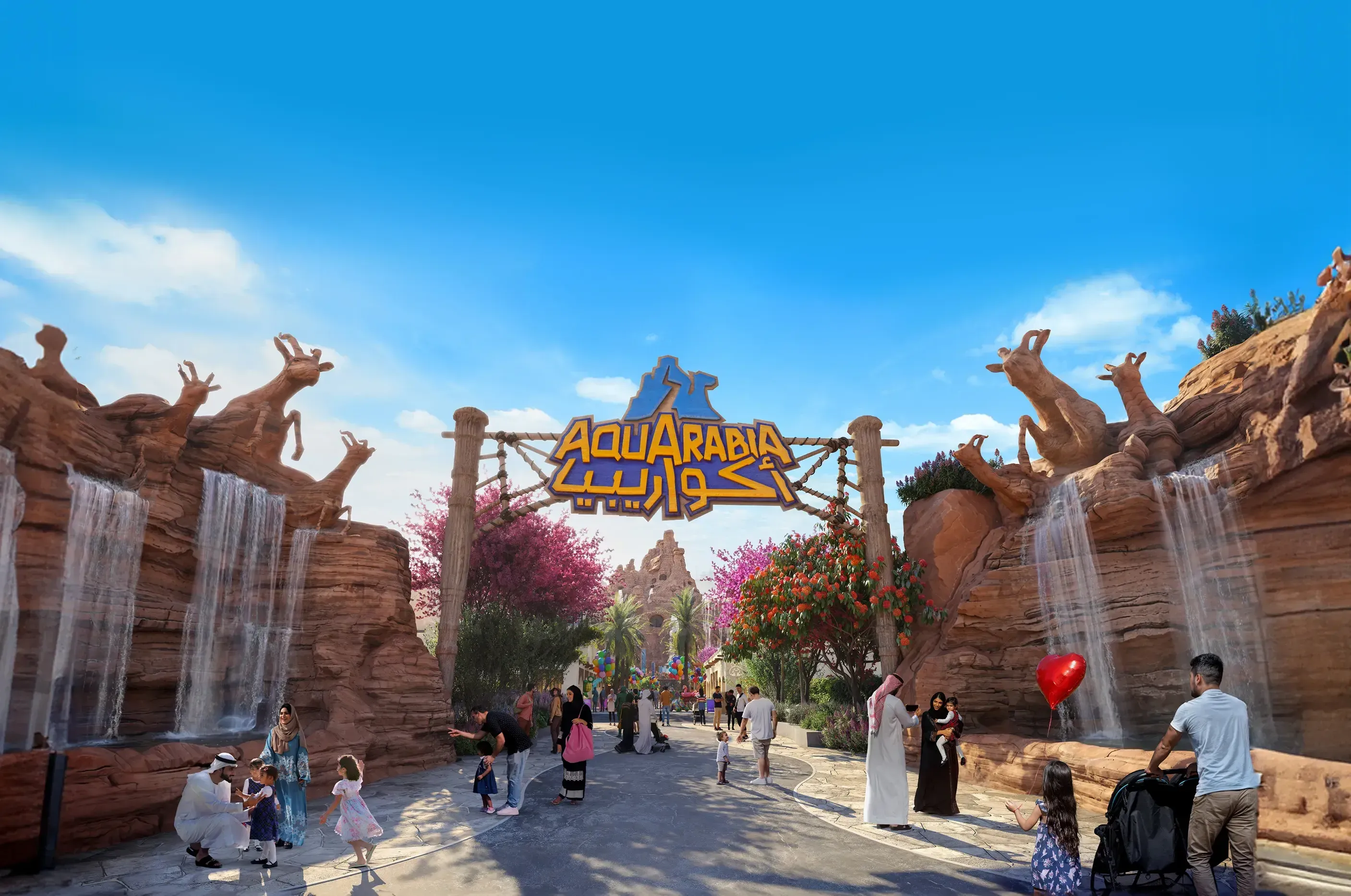
And yet, on the western edge of Qiddiya City, about 40 kilometres from central Riyadh, Aquarabia has opened its gates. Twenty-two rides, eight themed zones, five world records, and a surf pool in the middle of the Najd plateau. Saudi Arabia’s first water theme park is not a modest proposition. The official opening is set for April 23, 2026.
The Park That Took Nine Years to Build
Aquarabia was first announced in 2017, a flagship component of Qiddiya City, the entertainment giga-project that sits at the heart of Vision 2030’s quality-of-life agenda. Construction began in earnest in February 2022, and the park entered a soft launch phase on March 20, coinciding with Eid al-Fitr, offering exclusive preview access through a raffle for visitors to the adjacent Six Flags park. The official public opening follows on April 23.
The timeline matters. For almost a decade, Aquarabia existed as a rendering, a promise, and a question mark. Saudis who had grown up without a single licensed water park in the Kingdom watched construction progress through social media updates and site photographs.
When Six Flags Qiddiya City opened on the last day of 2025, the excitement was real but contained: a theme park was something the region had seen before. Aquarabia represented something else entirely. A water park, in Saudi Arabia, had simply never existed.
Eight Zones, One Thesis
The design of Aquarabia is not incidental. It was built around a deliberate narrative, developed by American experience design firm Falcon’s Creative Group, rooted in the indigenous wildlife and landscape of the Arabian Peninsula. The result is a park divided into eight zones, each named for and themed around a Saudi animal or terrain feature: The Den, Wave Wadi, Camel Rock, Herding Grounds, Arabian Peak, Surf Lagoon, Viper Canyon, and Dhub Grotto.
The camel was chosen as the park’s central icon, and the reasoning is not arbitrary. The camel’s association with water conservation, its ability to survive and move across landscapes that would kill almost anything else, makes it an unexpectedly apt symbol for a water park in a desert.
At the heart of the park rises Camel Rock Mountain, a towering sculpted formation that functions as both architectural landmark and social hub, housing a full-service restaurant at its peak with panoramic views across the park.
Animals across the zones are formed from rock rather than carved into it, a distinction that gives the environment a quality of geological discovery rather than theme park literalism.
Spanning more than 250,000 square metres, Aquarabia is a larger footprint than Dubai’s Aquaventure at Atlantis The Palm. It is an unusually thoughtful act of placemaking for an industry that often defaults to generic tropical aesthetics.
The Records
Aquarabia carries five world record claims, and they are not minor ones.
The centrepiece is Junoon Drop, a water coaster that stands 42.1 metres tall and runs 515.5 metres in length. It holds the record for the world’s tallest water coaster and incorporates the world’s first double water loop, a gravity-defying sequence that has no precedent in water park design anywhere.
The park also holds records for the tallest drop body slide through Speedy Jamezales, which features a 27.36-metre drop across 148 metres, the tallest water slide, and the longest mat racer.
Then there is Aquaticar: Legend of the Glowing Guardian, the world’s first underwater theme park ride with fully submersible vehicles, developed by Sub Sea Systems. The concept, an immersive aquatic dark ride, does not exist anywhere else on earth.
Meanwhile, Surftopia is the Kingdom’s first surf pool: a football field-sized basin generating waves up to two metres high with four customisable wave types for different skill levels. Surfing in Saudi Arabia, until very recently, meant travelling to a coast and hoping for conditions the Gulf and Red Sea can only occasionally provide. The idea that a reliable, programmable wave now exists inside a theme park outside Riyadh is the kind of detail that, even in the context of everything else Saudi Arabia has built in recent years, manages to surprise.
The Sustainability Question
A water park in one of the driest countries on earth inevitably invites a question about resources. The Qiddiya Investment Company has been deliberate in its response. Aquarabia uses specialised filtration systems designed to reduce water waste by up to 90 percent, with recycled water used for irrigation and cooling throughout the park. The design includes technology that connects ride structures to allow water transfer between different bodies, reducing overall consumption.
The 81 private climate-controlled luxury cabanas across the park point to another aspect of the operational challenge: running a water park in a climate where summer temperatures in Riyadh regularly exceed 45 degrees Celsius.
The cabanas, the shaded walkways, and the food and beverage infrastructure spanning 22 outlets all speak to a park designed not just for the rides but for the hours between them, when shade and cold air become the most urgent amenity of all.
What Qiddiya Actually Is
To understand Aquarabia, it helps to understand the city it sits inside. Qiddiya is not a theme park. It is a 367-square-kilometre master-planned city being built from scratch on the escarpment west of Riyadh, conceived as a permanent destination for entertainment, sports, and leisure.
Aquarabia and Six Flags represent the first two of what will eventually be dozens of attractions, including a Dragon Ball theme park, a dedicated esports arena and gaming district, a Formula One circuit, and a performing arts centre.
The project is backed by the Public Investment Fund and has been valued by Knight Frank at close to ten billion dollars.
Abdullah Al-Dawood, managing director of Qiddiya Investment Company, has described the development cadence plainly: something new, every three months, every year. Aquarabia is the second chapter of that story.
The Bigger Picture
Saudi Arabia had no licensed cinemas until 2018. It had no public concerts until around the same time.
The idea of a mixed-gender family spending a day on waterslides, eating at outdoor restaurants, and surfing artificial waves in the Najd desert would have been difficult to imagine in the Kingdom a decade ago. It is now a ticketed reality.
That shift is the context in which Aquarabia should be read. The park is, among other things, a statement about what Saudi leisure looks like in 2026: large-scale, globally ambitious, rooted in Saudi identity rather than imported wholesale from elsewhere, and aimed squarely at a young population that has grown up with the promise of something different and is only now beginning to receive it.
Whether Aquarabia is the world’s greatest water park is a question that visitors will answer over time.
Whether it is a significant moment in the story of what Saudi Arabia is becoming: on that, the evidence is already in.
Aquarabia Qiddiya City officially opens on April 23, 2026. Tickets are available at aquarabiaqiddiyacity.com.

Comments (0)