


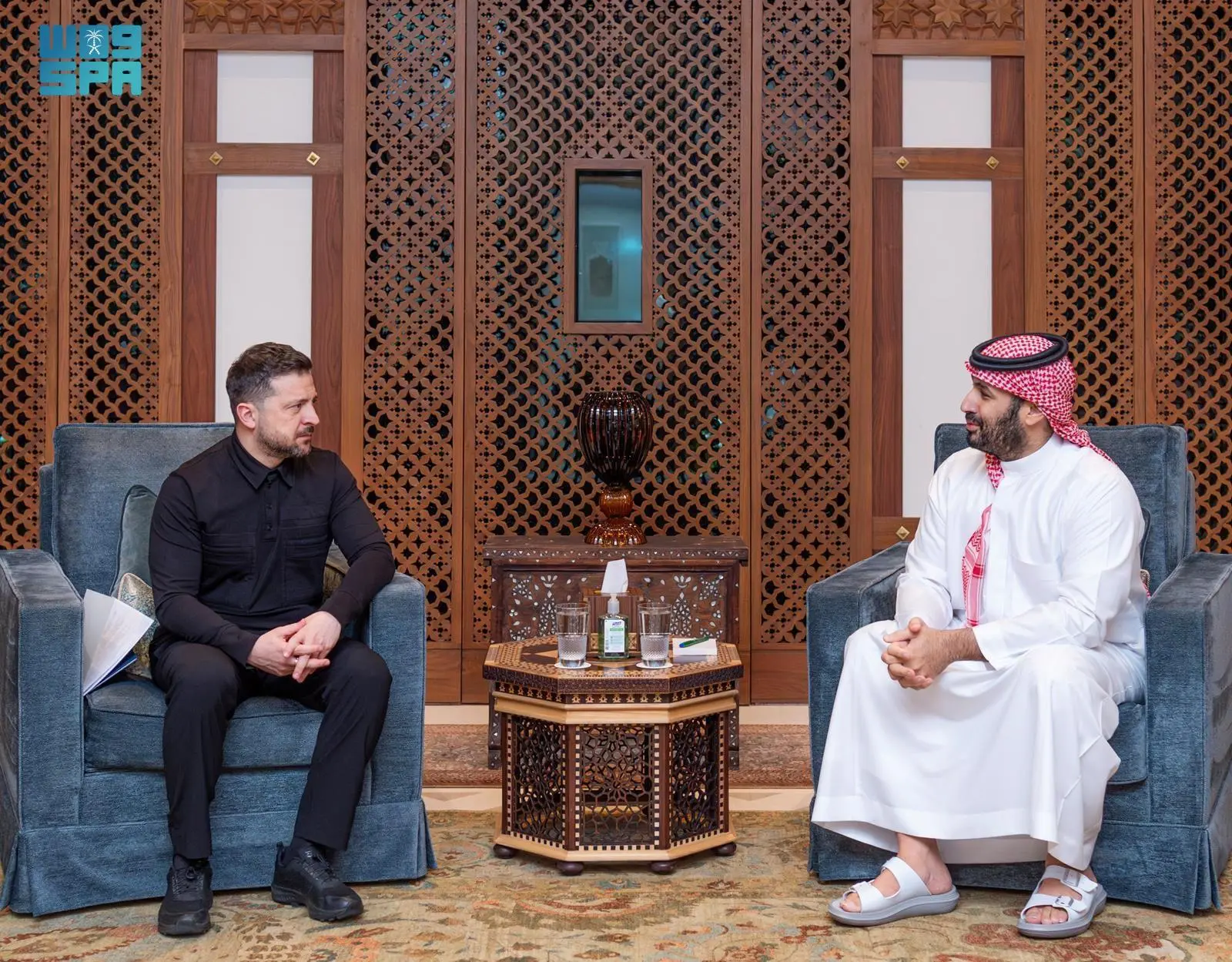
When Volodymyr Zelensky’s plane touched down in Saudi Arabia on 26 March, the Ukrainian president called his visit simply “important meetings”. The phrase undersold it. At a moment when Iran’s war has brought missile and drone threats back to the top of Gulf security agendas, the choice to fly to the Kingdom was a recognition that Riyadh has become one of the key capitals where the European and Middle Eastern fronts now meet.
Ukraine is not coming to ask for help in a vacuum. It is coming with something Saudi Arabia wants: hard‑won experience in defending cities, power plants and front lines against waves of Iranian‑designed Shahed drones. Saudi Arabia is not hosting out of charity. It is consolidating its role as a security partner and regional hub at a time when its airspace, energy infrastructure and regional allies are under pressure.
From Summit Host to Security Partner
This week’s visit builds on a relationship that has shifted quickly over the past three years. In 2023 and 2024, Saudi Arabia hosted Ukraine‑related talks in Jeddah and welcomed Zelensky to Arab League and other summits, positioning itself as a diplomatic bridge between Kyiv and countries of the Global South. Those meetings were framed largely in terms of mediation and dialogue.
By early March 2026, the conversations had moved to a much harder edge. On 7 March, Zelensky and Crown Prince Mohammed bin Salman held a call to discuss what Ukrainian and Saudi readouts both described as “the security situation in the Middle East and the Gulf region” and “countering threats from the Iranian regime”. According to Ukrainian news agency UNN, Zelensky told the crown prince that Ukraine was already helping “about five countries” in the region with advice on how to defend against Iranian drones and was ready to deepen that cooperation with Saudi Arabia.
He stressed that “no other country in the world currently has such experience” of fighting off Shahed‑type systems at scale, and suggested that this experience could be used to strengthen Gulf air defence. For Saudi Arabia, which has its own long record of intercepting drones and missiles launched from Yemen and is now watching the Iran conflict closely, this was an offer from a partner whose battlefield lessons could be integrated into a Saudi‑designed security architecture.
Drones, Iran and Why Ukraine’s Experience Matters
The common denominator in these talks is the Shahed drone family. In Ukraine, Russian forces have used Iranian‑origin Shahed‑131 and Shahed‑136 attack drones in repeated night‑time waves against cities and energy infrastructure. Ukrainian air defence units have spent more than two years learning how to detect, jam and shoot down hundreds of such targets in complex salvos, often combining low‑flying drones with missiles.
In the wider Middle East, similar systems have appeared in Iranian and proxy arsenals, including in attacks on shipping, energy infrastructure and, more recently, during the opening phases of the Iran war. Saudi Arabia has spent years investing in layered defences that include Patriot and THAAD batteries, indigenous systems and an increasingly sophisticated command and control architecture. Yet both Ukrainian and Saudi officials understand that the cat‑and‑mouse game between cheap, expendable drones and expensive interceptors cannot be left to existing doctrine.
This is where Ukraine’s offer becomes strategically interesting to Riyadh. Ukrainian units have developed playbooks for handling multi‑vector drone attacks at scale, from radar and thermal tracking to electronic warfare and the use of cheaper interceptors and guns where possible. They have also worked with Western partners on integrating new software and AI‑assisted tools into their air defence networks.
Saudi Arabia, for its part, has declared 2026 the “Year of Artificial Intelligence”, and defence is one of the sectors where AI applications: faster target recognition, decision support, predictive maintenance are being prioritised. Tactical Report, a regional intelligence outlet, notes that Saudi defence planners are examining AI for drone detection and counter‑UAV systems as part of a broader modernisation of air defences. The prospect of combining Saudi investment and infrastructure with Ukrainian operational know‑how is at the heart of the discussions now taking place.
What Each Side Wants
For Saudi Arabia, Zelensky’s visit is an opportunity to add another layer to its security partnerships without becoming dependent on any single supplier. By engaging directly with Ukraine, the Kingdom can:
- Diversify its defence toolkit, adding Ukrainian experience to existing cooperation with the United States, Europe and other partners.
- Enhance protection of critical infrastructure, from oil and gas facilities to data centres and airports, at a moment when regional tensions are high.
- Consolidate its status as a global security interlocutor, able to bring actors from different theatres – Europe, the Gulf, even Asia – into Riyadh and Jeddah for serious, technical discussions.
For Ukraine, the calculus runs in parallel. Kyiv gains:
- Political recognition in the Gulf, reinforcing that it is not limited to a Euro‑Atlantic axis and can be a contributor to Middle Eastern security.
- Potential financial and technological support, including interest from Gulf sovereign funds in reconstruction and technology projects.
- A platform for its “peace formula” and post‑war vision, articulated in a region that has its own long experience with conflict and resolution attempts.
Neither side is doing the other a favour. Ukraine brings a form of expertise that Saudi Arabia views as useful at a specific moment in regional security; Saudi Arabia brings scale, resources and political weight that Ukraine cannot find elsewhere in the Arab world.
A New Layer in Saudi Foreign Policy
Seen from Riyadh, Zelensky’s arrival fits a broader pattern. In the span of a few months, Saudi Arabia has:
- Climbed to forty‑sixth place in the Global Innovation Index, with gains in human capital, research and infrastructure.
- Declared 2026 the “Year of Artificial Intelligence”, backed by an estimated USD 9.1 billion in AI investments and flagship projects such as Humain’s Arabic large language model and a rapidly expanding data centre network.
- Continued to expand its role in regional diplomacy around Iran, energy markets and now cross‑regional security linkages.
In that context, a Ukrainian presidential visit is an expression of what Saudi foreign policy increasingly looks like: multi‑directional, technologically savvy and anchored in the idea that the Kingdom is a place where global crises are discussed, and sometimes mitigated, rather than simply felt.
If the talks this week move forward, the result may be a combination of training, technology sharing and perhaps formal agreements on air security cooperation, as some international outlets have suggested. But even before any documents are signed, the optics are telling. In 2026, when leaders think about how to connect Europe’s wars, Iran’s threats and the Gulf’s defence, Riyadh is one of the capitals they fly to.


Comments (0)