


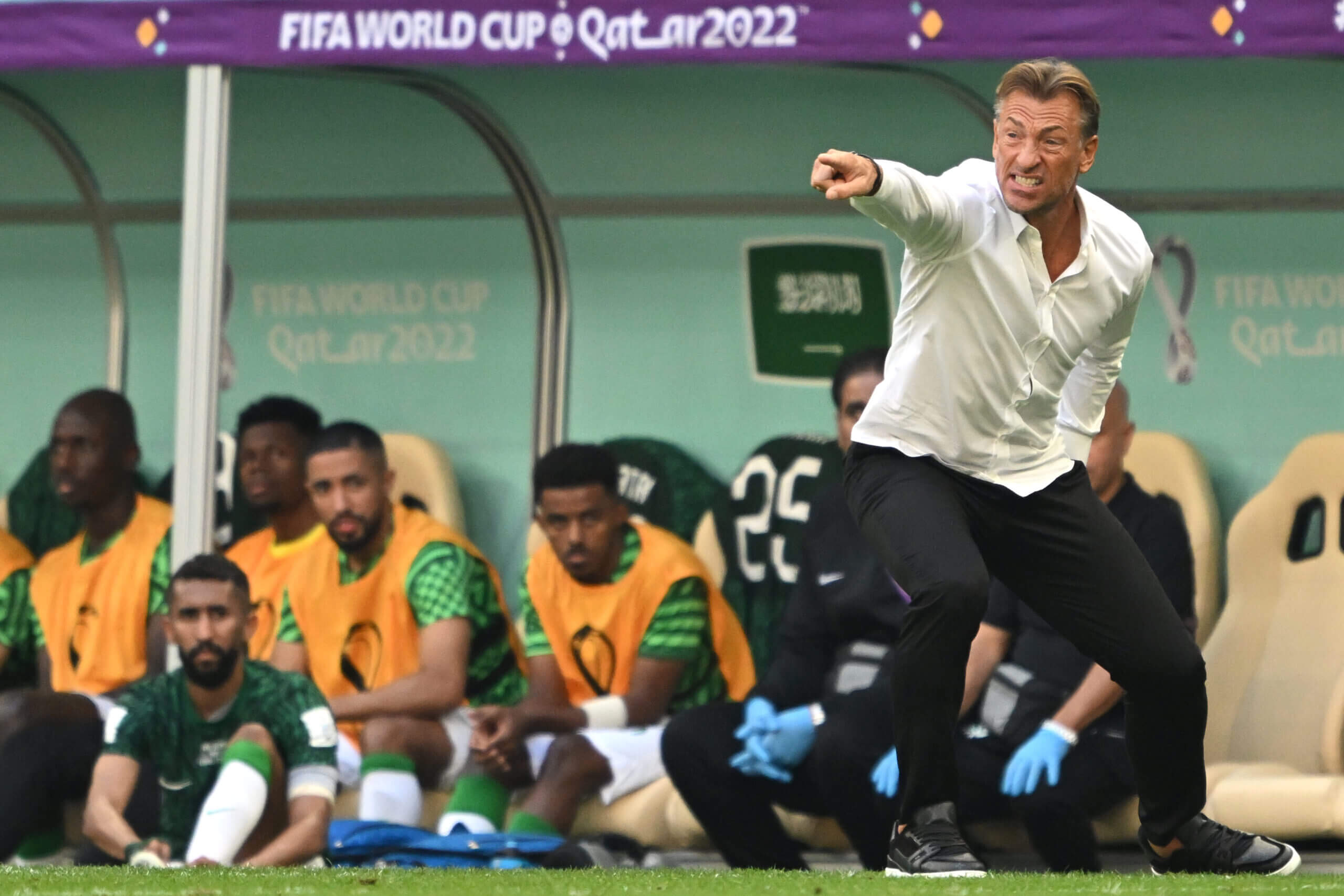
Less than two months before Saudi Arabia’s opening fixture at the 2026 FIFA World Cup, the Saudi Football Federation made a decision that surprised almost everyone. On Thursday, the federation confirmed it had dismissed Hervé Renard and appointed Georgios Donis as the new head coach of the Green Falcons.
The official announcement came just days after transfer journalist Fabrizio Romano reported that an agreement had been reached. The timing is extraordinary. Saudi Arabia kicks off its World Cup campaign against Uruguay on June 15. Donis takes charge with fewer than 55 days to prepare.
Why Renard Was Shown the Door
Hervé Renard’s second spell as Saudi Arabia coach was supposed to be a homecoming. The Frenchman returned to Riyadh in October 2024 to replace Roberto Mancini, whose own tenure had ended in considerable disarray. Renard was the man who had guided Saudi Arabia to one of the most celebrated upsets in World Cup history: the 2-1 victory over Argentina at Qatar 2022, a result that stopped the world for 90 minutes and made Saudi football briefly famous everywhere.
That legacy bought goodwill. It did not survive the results. Saudi Arabia lost 4-0 to Egypt and 2-1 to Serbia in March 2026 friendlies, performances that exposed serious problems in the squad’s cohesion and defensive organisation at precisely the moment the team needed to be building momentum. The federation had seen enough. Within weeks of those results, Renard’s departure was confirmed, bringing his second chapter to a close after roughly eighteen months.
Renard leaves with his broader reputation intact. His record across Africa, where he won the Africa Cup of Nations with Zambia in 2012 and with Ivory Coast in 2015, making him the first coach to win AFCON with two different nations, remains remarkable. His Saudi chapter will be remembered for the Argentina result and for little else.
Who Is Georgios Donis?

The appointment of Donis is unusual in several respects, the most obvious being that it represents his first job in international management. The 56-year-old Greek coach has spent his career almost entirely at club level, building a reputation as a tactically disciplined and organised manager with a particular strength in defensive structure.
As a player, Donis was a Greek international who earned 24 caps for his country and had a career that took him through English football, including spells at Blackburn Rovers, Sheffield United, and Huddersfield Town, before returning to Greece for the later stages of his career. He went into management after retiring, coaching Panathinaikos and Maccabi Tel Aviv among others before arriving in Saudi Arabia.
His most recent position was at Al-Khaleej in the Saudi Pro League, a role he had held since 2024. The federation cited his familiarity with Saudi football as a decisive factor in his appointment: he knows the players in the domestic league, understands the rhythms of Saudi football, and does not need time to acclimatise to an environment he has been working in for the past two years. Whether that familiarity translates into effective international management of a squad under World Cup pressure is a different question entirely.
Donis is expected to take charge of the national team officially from May 22, following the conclusion of the domestic Saudi Pro League season. That leaves him with roughly three weeks of preparation before the tournament begins, with a friendly against Ecuador on May 30 pencilled in as the final pre-tournament fixture.
What Saudi Arabia Faces in Group H
The task Donis inherits is difficult but not impossible. Saudi Arabia has been drawn into Group H alongside Spain, Uruguay, and Cape Verde. On paper, it is a demanding group: Spain arrive at the tournament as genuine contenders, and Uruguay carry decades of World Cup pedigree and a squad built around experienced top-flight European players. Cape Verde, however, represent a genuinely achievable target, and a victory there combined with a competitive performance against one of the bigger sides could be enough to open a path to the knockout rounds.
That would be history. Saudi Arabia has never progressed beyond the group stage in a World Cup. The federation’s ambition for North America is to change that, and it has been willing to make an extraordinary last-minute managerial change in pursuit of that outcome. Whether the gamble pays off will be one of the more interesting subplots of a tournament already rich with them.
The Bigger Picture
The coaching change sits within a broader story of Saudi football’s ambition and impatience. The Kingdom has invested enormously in its domestic game over the past three years, bringing a generation of global stars to the Saudi Pro League and raising the profile of Saudi football internationally. The expectation that the national team should reflect that investment, and deliver results on the world stage, has grown accordingly.
Mancini was hired, struggled to connect with his squad, and was replaced. Renard returned with enormous goodwill, posted bad results, and was dismissed. Donis arrives with none of the name recognition of either predecessor but with something the federation has decided matters more right now: knowledge of the players he will be working with and no time to waste learning who they are.
Saudi football has two months to find out whether that calculation was right.
Saudi Arabia begin their 2026 FIFA World Cup campaign against Uruguay on June 15. Their group also includes Spain and Cape Verde.




Comments (0)