


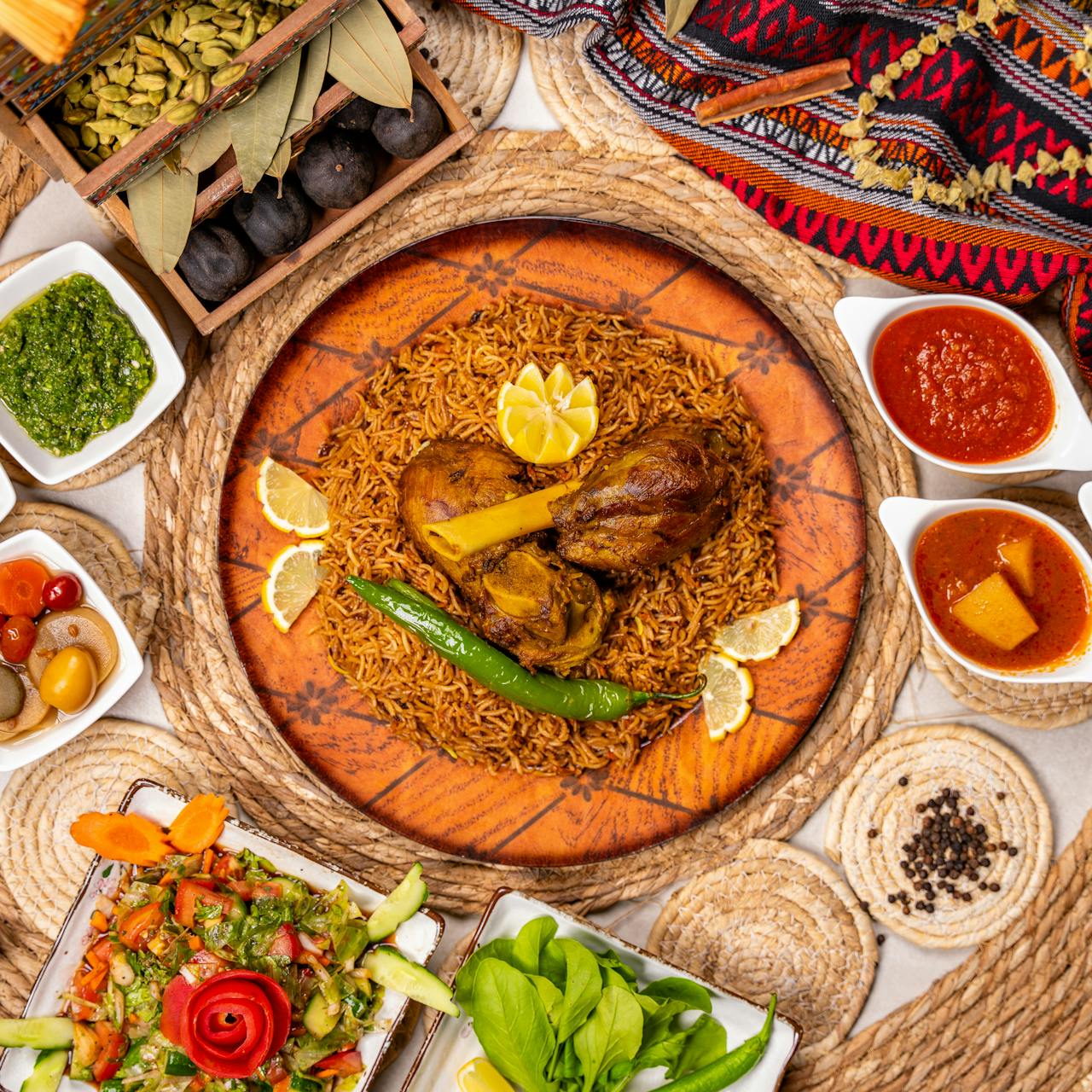
There is a saying in Saudi Arabia that a guest who has not been offered kabsa has not truly been welcomed. The dish sits at the centre of the Kingdom’s food culture with a permanence that few national dishes anywhere in the world can match. It appears at weddings, at funerals, at Friday family lunches, and at the tables of strangers who have just met.
To understand kabsa is to understand something real about how Saudi society works.
One Pot, One Word
The name comes from the Arabic root kbs, meaning to press or squeeze, a reference to the cooking method: everything goes into one pot. Rice, meat, vegetables, and spices are combined and cooked together, each element absorbing the flavour of the others until the result is something greater than any individual ingredient. It is a dish built on the logic of accumulation, which is also, in many ways, the logic of hospitality in the Gulf.
The base is long-grain basmati rice, cooked in the broth produced by simmering the meat. The spice blend is what gives kabsa its character: black lime, known as loomi, is perhaps the most distinctive element, lending a dry, tart depth that has no close equivalent in other regional cuisines. Around it orbit cardamom, cinnamon, cloves, bay leaves, and saffron, a combination that reflects the spice trade routes that ran through the Hejaz for centuries, connecting the Arabian Peninsula to India, Persia, and East Africa. The meat is most commonly chicken or lamb, though goat, camel, fish, and shrimp all appear in regional variations.
The dish is finished with fried onions, toasted almonds, pine nuts, and sometimes raisins or sultanas, a sweet note against the savoury depth that surprises first-time eaters and pleases everyone after. Daqqus, a home-made tomato sauce, is served alongside.
Where It Came From
The origins of kabsa are contested in the way that the origins of any beloved national dish tend to be. The most widely held account traces it to the Bedouin tribes of the Arabian Peninsula, for whom a one-pot meal of rice, meat, and available spices was both practical and portable. The desert demanded efficiency: one fire, one vessel, one dish that fed many.
A competing theory connects it to Yemeni mandi, the slow-cooked pit-roasted rice dish that remains one of the most celebrated preparations in the southern Arabian Peninsula. The techniques overlap: mandi uses a tannour, an underground oven in which a whole lamb is sealed and cooked over hours, and the resulting meat is served over fragrant rice. Kabsa has absorbed the spirit of mandi while adapting it for a different context.
A third theory, less discussed, points to the Andalusian spice traders who passed through the Hejaz and whose influence on the region’s cooking runs deeper than is commonly acknowledged. The structural resemblance between kabsa and certain Spanish rice preparations is notable, though causality is difficult to establish across that distance of time.
What is clear is that kabsa accumulated influences as the Peninsula accumulated trade. The Indian subcontinent contributed the basmati rice and the layered spice logic. Persia contributed saffron and the culture of aromatic rice cookery. East Africa contributed techniques and ingredients that arrived through the Red Sea ports. The dish that resulted was not borrowed from anywhere; it synthesised everything.
A Kingdom of Variations
Saudi Arabia is not a single culinary landscape, and kabsa reflects that. The dish varies significantly by region in ways that are taken seriously by those who grew up eating a particular version.
In Najd, the central plateau that forms the heartland of Saudi identity, kabsa tends toward the spicier end of the spectrum. The Najdi version is typically richer and more aromatic, cooked over longer periods, and often prepared with lamb for significant occasions.
In the Hejaz, the western coastal region that encompasses Mecca, Medina, and Jeddah, kabsa is generally milder and more tomato-forward, reflecting a history of trade and a more cosmopolitan palate shaped by centuries of pilgrimage traffic from across the Muslim world.
]In the south, particularly in the Aseer highlands, kabsa is often cooked over firewood in traditional metal pots, a method that imparts a smokiness to the rice that is distinctly regional. In the Eastern Province, the dish sometimes incorporates seafood, particularly in coastal communities where fish and shrimp are readily available.
These are not trivial distinctions. Saudis speak about regional kabsa with the kind of specificity that the French bring to regional cheese or the Italians to pasta shapes. The version your grandmother made, and the spice balance she calibrated over decades of cooking, is understood to be different from the version served in a restaurant in another city.
The Social Architecture of a Shared Plate
Kabsa is eaten communally, from a large central platter, typically placed on a floor mat or a low table around which diners sit. The tradition is to eat with the right hand, breaking off pieces of meat and combining them with rice pressed lightly together. The shared platter is not incidental to the experience: it is the point. The physical proximity, the common plate, the rhythm of eating together, these are the formal expression of the hospitality that kabsa is meant to embody.
The dish is the first thing placed in front of an important guest. It is the centrepiece of wedding feasts, where enormous quantities are prepared over outdoor fires for hundreds of guests. It is the meal that young Saudi men, away from home for the first time at university or working abroad, learn to cook as a matter of both survival and identity. The ability to make a decent kabsa is understood, across generations and genders, as a basic expression of being Saudi.
In 2021, the Ministry of Culture announced an initiative to formally promote kabsa as part of the Kingdom’s national heritage under Vision 2030, a recognition that the dish had always occupied culturally but had never been given in official terms. The move sat alongside broader efforts to document, preserve, and celebrate Saudi culinary traditions as the country opened to international tourism and the world began to pay attention to what Saudi food actually was.
Beyond the Peninsula
Kabsa is eaten across the Gulf Cooperation Council, where it is considered a shared national dish rather than a Saudi one specifically. In Kuwait, Qatar, Bahrain, and the UAE, versions of the dish appear under slightly different names and with slightly different spice profiles. Makboos and Machboos are the Gulf Arabic variants of the name. The dish also appears in parts of southern Iran and in Gaza, where it arrived through the long networks of trade and migration that have always connected the Arabian Peninsula to its neighbours.
Internationally, kabsa has begun to travel. Saudi restaurants in London, Washington, and Sydney serve it to diaspora communities and curious visitors. Food media has picked it up as part of a broader rediscovery of Gulf cuisine, which for years was overshadowed internationally by the more familiar profiles of Lebanese and Moroccan cooking. That is changing, partly because Saudi Arabia is changing, and the country’s decision to open to tourism has brought a new audience into contact with its food for the first time.
What Remains
What makes kabsa endure, beyond its flavour, is its flexibility. It accommodates the ingredients available, the preferences of the region, and the occasion being marked. A simple weeknight kabsa and a wedding feast kabsa share the same name and the same structural logic while being almost entirely different experiences. The dish scales up or down, adjusts to what is at hand, absorbs new influences without losing its character.
That is also a description of the culture that produced it. Saudi Arabia has absorbed centuries of trade, migration, and exchange, and the dish that came out of that process feeds millions of people every day and has done so, in some recognisable form, for as long as anyone can trace it. It is, in the plainest and most complete sense, what a national dish should be.
Comments (0)