


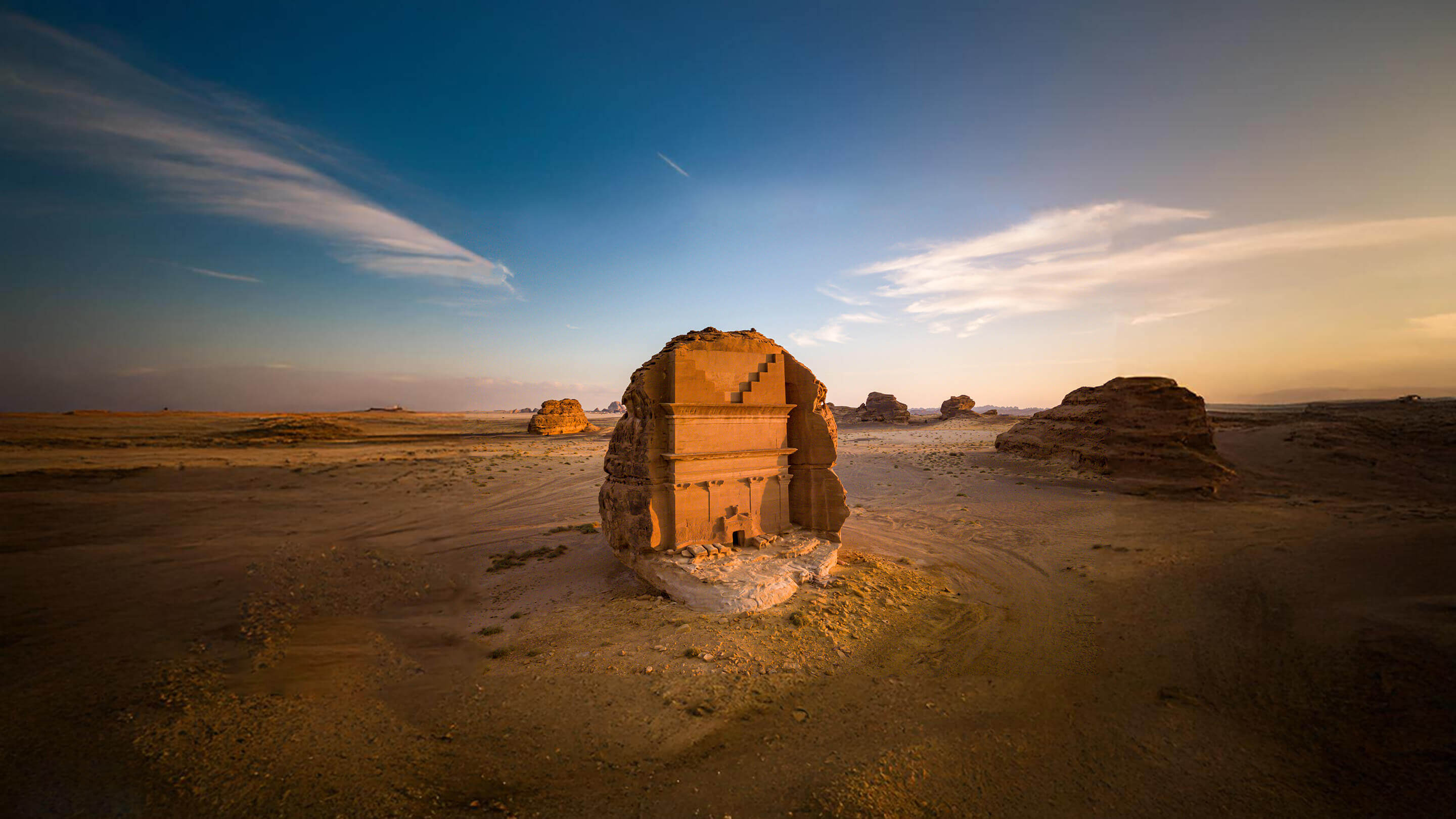
The first thing to understand about Hegra is that almost nobody has heard of it. The second thing to understand is that this is one of the most extraordinary archaeological sites on earth.
Two thousand years ago, in the deserts of what is now northwestern Saudi Arabia, a civilisation called the Nabataeans built a city carved into the sandstone. They cut more than 110 monumental tombs into rock faces scattered across an area of more than thirteen kilometres. They commissioned master sculptors to decorate the tomb facades with elaborate columns, friezes, eagles, winged lions, and inscriptions that named the deceased, the owner, and sometimes the artist himself. They engineered an oasis in a place that should not have sustained one, drawing water from deep wells and channelling it through cisterns and channels carved into the same rock that held their dead. And then, sometime around the second century AD, they left, and the desert kept their work almost perfectly intact for the next two thousand years.
The city is called Hegra. It is also known as Al-Hijr in Arabic and Madain Salih, the Cities of Salih, in later Islamic tradition. It sits within the wider region of AlUla, about twenty kilometres from the modern town. In 2008, it became Saudi Arabia’s first UNESCO World Heritage Site. For most of the period since, virtually no one outside the Kingdom has been allowed to see it.
That changed in 2019.
The Sister City of Petra
Most travellers who arrive in Hegra do so with Petra in their minds. The comparison is inevitable and not inaccurate. Hegra was the Nabataeans’ second city, after Petra in modern-day Jordan, and the architectural language of both sites is unmistakably the same. The rock-cut facades, the funerary chambers carved deep into sandstone, the distinct Nabataean style that blends Greek, Egyptian, and Mesopotamian influences into something singular: all of this is present in both cities.
But Hegra is not a smaller Petra. It is a different experience entirely, and in some respects a more remarkable one.
Petra is dense. Its tombs and monuments crowd against narrow sandstone canyons, and the most famous facade, Al-Khazneh, reveals itself dramatically through a slot in the cliff face. Hegra is the opposite. Its tombs are spread across a vast desert plain, isolated against open sky, the spaces between them as much a part of the experience as the structures themselves. Where Petra’s beauty is theatrical, Hegra’s is solitary. You walk for long minutes between tomb clusters across sand and stone, the silence broken only by wind, and you understand viscerally that this place was built for the dead and meant to remain undisturbed.
The state of preservation at Hegra is, by archaeological standards, extraordinary. UNESCO’s inscription documents note that the site’s authenticity is owed in significant part to its early abandonment and the protective effect of an extremely arid climate. There was no medieval rebuilding, no Ottoman repurposing, no significant looting of structures, and almost no resettlement. What the Nabataean sculptors left in the first century AD is, in many cases, what you see today.
Who the Nabataeans Were
To understand Hegra you have to understand the people who built it. The Nabataeans were originally a nomadic Arab tribe who gradually settled along the trade routes that crossed the Arabian Peninsula between the fourth century BC and the second century AD. What made them wealthy was not agriculture or conquest but their control of the caravan routes that carried frankincense, myrrh, spices, and other luxury goods from southern Arabia to the Mediterranean.
They were extraordinary water engineers, an ability that mattered more than any other in the desert. Across their territory, from Petra in the north to Hegra in the south, the Nabataeans developed systems of cisterns, channels, and wells that allowed them to settle landscapes which no previous civilisation had successfully inhabited. The result was an empire of trading cities scattered across the desert, each one improbably sustained by water management techniques that took centuries to develop.
The Greek geographer Strabo, writing in the first century AD, described the Nabataeans as a people governed by royalty but practising a strong spirit of democracy, with labour shared across the community. They worshipped a pantheon of deities, chief among them Dushara, the Lord of the Mountain, whose name appears in inscriptions across both Petra and Hegra. They wrote in a script that became the direct ancestor of modern Arabic writing, a fact that means the Nabataeans gave the Arab world not only its trading infrastructure but its alphabet.
Hegra was their southern outpost. It sat at the meeting point of trade routes from Yemen, the Mediterranean, Egypt, and Mesopotamia. By the time the city reached its peak around the first century AD, it had become the second-largest Nabataean city after Petra itself.
The Tombs
There are 111 monumental tombs at Hegra, by the count UNESCO uses, though more recent archaeological work has documented as many as 131 spread across the wider site. Ninety-four of them are decorated, with facades that range from the relatively simple to the extraordinarily elaborate. Many of them carry inscriptions naming the tomb’s owner, the family who would be buried inside, and the year of construction. A small number even name the master sculptor responsible for the work.
Qasr al-Bint, the Palace of the Maiden, is the largest tomb facade at Hegra, rising sixteen metres above the desert floor. Above its raised portal sits an inscription identifying it as the work of a sculptor named Hoor ibn Ahi, commissioned for Hani ibn Tafsy and his descendants, and dated to the fortieth year of the reign of the Nabataean king Aretas IV. That corresponds to roughly 31 AD. The level of biographical detail is what makes Hegra exceptional. We know the names of the dead. We know the names of the carvers. We know when the work was completed and for whom. There is no other ancient site in the region that offers this depth of documentary record.
Qasr al-Farid, which means The Lonely Castle, is the most photographed tomb at Hegra and one of the most striking pieces of ancient architecture anywhere. It stands alone on the open plain, cut into a single isolated outcrop of sandstone, visible from across the site. The tomb was never finished, and the lower third of its facade carries the rough chisel marks of unfinished work, a detail that reveals to modern archaeologists exactly how Nabataean sculptors approached a project: from the top down, working the upper carved details first and descending toward the base.
To the east of the main tomb clusters, a natural fissure in the rock leads through Jabal Ithlib, a mountain sanctuary where the Nabataeans practised their religion. Visitors enter through a Siq, a narrow rock corridor that opens into a larger chamber known as Al Diwan, carved directly into the cliff face and used as a meeting hall and banqueting room for the city’s leaders. The space is unlit, cool, and almost completely silent, and standing inside it is one of the more unforgettable experiences the site offers.
Why You Had Never Heard of It
The reason Hegra is not as famous as Petra has less to do with the site itself and more to do with the country surrounding it.
For most of its modern history, Saudi Arabia was closed to almost all non-Muslim foreign travel. International archaeological access was extremely limited until the early 2000s, and tourism in the sense that the rest of the world understood it simply did not exist. There was also a religious dimension: the Nabataeans were a pre-Islamic civilisation, and Hegra is associated in Quranic tradition with the people of Thamud, a community that, according to scripture, rejected the prophet Salih and was punished by God. For some Saudis, the site carried associations that made encouraging tourism to it culturally complicated. Whatever the reasons, Hegra remained largely invisible to the outside world even after its UNESCO designation in 2008.
That changed with Vision 2030 and the broader opening of the Kingdom to international tourism in 2019. AlUla, the region containing Hegra, was identified as the centrepiece of Saudi Arabia’s cultural tourism strategy. The Royal Commission for AlUla was established to manage the site and the wider region. A major Franco-Saudi archaeological partnership, in place since the same year the site received UNESCO inscription, has continued to document and protect the area. Hegra opened to tourists, carefully and with controlled access, and has gradually become one of the most spoken-about destinations in Middle Eastern tourism.
How to Visit
Visiting Hegra is not a matter of buying a ticket and wandering. The site is vast, much of it still unexcavated, and access is tightly managed for reasons of both conservation and security. Tours are organised through Experience AlUla, the official tourism authority, and depart from the Winter Park Visitor Centre in AlUla. The guides are knowledgeable, the buses are air-conditioned, and the experience is unhurried but structured. Independent exploration is not permitted.
The best time to visit is during the cooler months from October through April. Summer temperatures in AlUla regularly exceed forty degrees Celsius, which makes the experience genuinely difficult, though the upside is significantly fewer crowds. The intermediate seasons of late autumn and early spring offer the best balance of weather and visibility.
AlUla itself has developed substantially as a destination in the years since Hegra opened. There are now luxury resorts, boutique hotels, and a growing roster of seasonal events including the AlUla Arts Festival in early winter and Desert Polo and trail running events that draw international visitors. The Royal Commission has deliberately positioned AlUla as a high-quality, low-density destination, with visitor numbers controlled to preserve both the experience and the site itself. This is not a place you fly to for a weekend break. It is somewhere you go for several days, ideally, and the trip rewards the time.
What It Means
There is something genuinely moving about standing in front of a tomb in Hegra that has not been touched since the first century. The names of the buried, carved by hand into rock two thousand years ago, are still legible. The eagle that guards the portal still has the feathers picked into its wings by a sculptor whose own name is recorded on the same wall. The desert that the Nabataeans tamed is still a desert, but the wells they sank are still there, and parts of the irrigation system they engineered still hold water.
For Saudi Arabia, the opening of Hegra has been about more than tourism revenue. It has been about establishing in the global imagination that the Arabian Peninsula has a deep, layered, pre-Islamic history that belongs to world heritage rather than to any single tradition. The Nabataeans were Arabs, but their script gave rise to Arabic, their trade routes connected three continents, and their architecture remains one of the great achievements of the ancient world. That story is now being told in the country where the southern half of it played out, and it is being told to a global audience for the first time.
The Lonely Castle is still standing in the open desert. The Palace of the Maiden still bears its sculptor’s signature. The Siq still opens into Jabal Ithlib’s silent chamber. For two millennia, almost no one was allowed to see them. Now they are waiting.
Comments (0)