


On the iconic external gates of UNESCO Headquarters in central Paris, where hundreds of thousands of people pass each month between the Place de Fontenoy and the Eiffel Tower, a public photography exhibition has quietly opened that says something important about where heritage tourism is going.
The exhibition is called I Am a Rawi: Sharing Stories from AlUla. It runs until 31 August. It is free. And its subject is a group of Saudi storytellers whose work, if it proves as influential as UNESCO clearly believes it will, may help reshape how visitors engage with the past across the wider world.
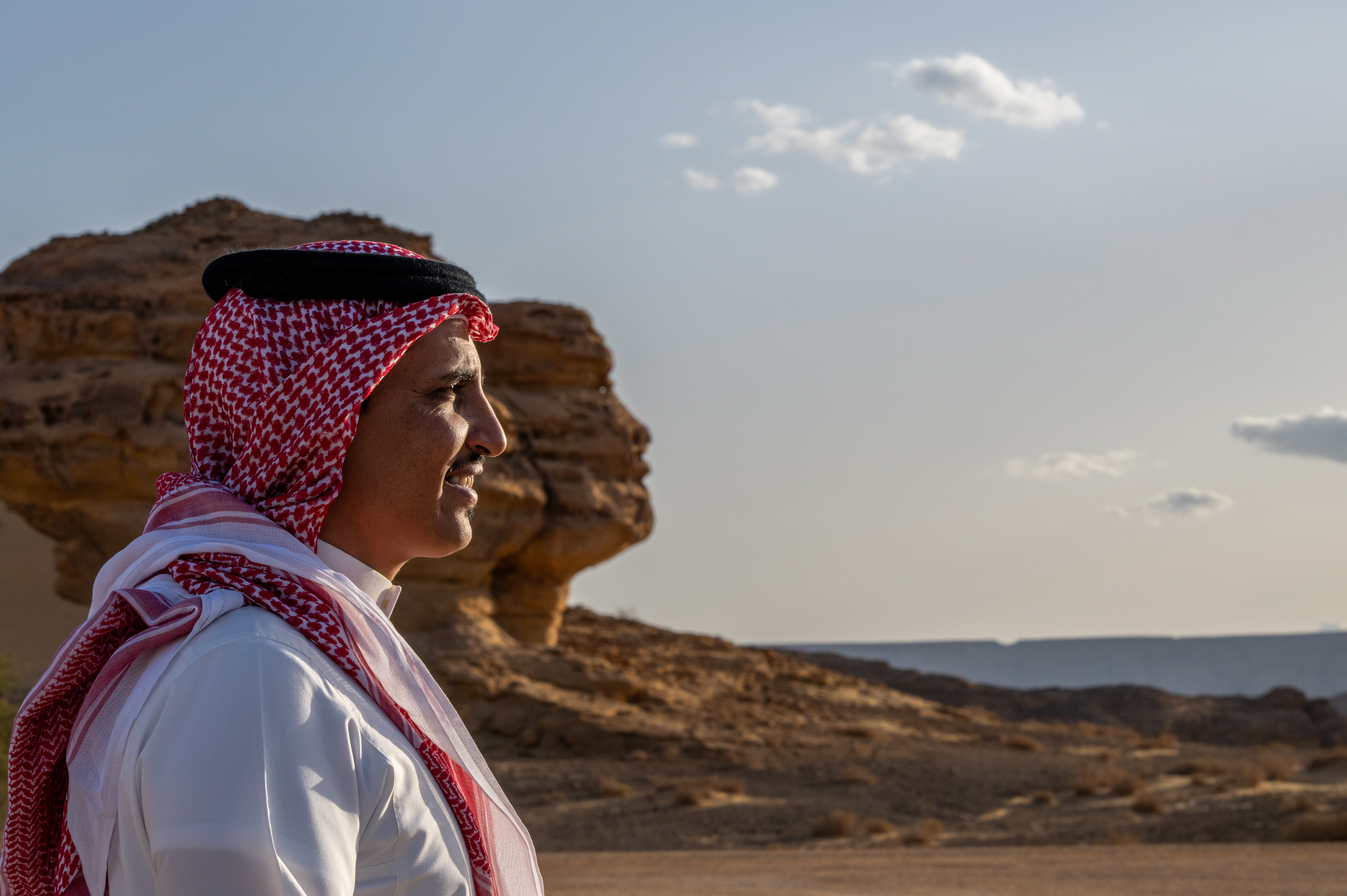
The Arabic word rawi translates simply as storyteller. In the context of AlUla, the ancient oasis in northwestern Saudi Arabia that became the country’s first opening to international tourism in 2020, the term has taken on a more specific meaning.
The Rawis are Saudi nationals, the majority from AlUla itself, who have undergone extensive training to serve as cultural guides at the region’s four principal heritage sites: Hegra, the Nabataean city that became Saudi Arabia’s first UNESCO World Heritage Site; ancient Dadan, capital of the Dadan and Lihyan kingdoms and one of the most developed cities of the first millennium BCE in the Arabian Peninsula; Jabal Ikmah, an open-air library of hundreds of pre-Islamic inscriptions in multiple languages, now listed on UNESCO’s Memory of the World Register; and AlUla Old Town, a labyrinth of more than 900 mudbrick homes whose origins reach back at least to the twelfth century. Together, these sites witness more than 200,000 years of human history.
The Rawi role was not an accident of the AlUla tourism rollout. It was a deliberate design choice, made by the Royal Commission for AlUla in collaboration with UNESCO, that decided very early that the region’s offering to international visitors would be built around storytelling rather than signage. Visitors to Hegra do not walk among the Nabataean tombs reading interpretive panels. They walk with a Rawi who tells them, in the cool early evening light of the desert, what the tombs are, who built them, and why the Nabataeans chose this exact stretch of sandstone for their southern necropolis. The information is the same. The mode of delivery, the human voice carrying the story directly to the listener, transforms it.
Qissa bi Qissa: The Live Museum Comes to AlUla
The UNESCO partnership has now produced something more ambitious. Over the past several months, the Rawis have worked with UNESCO to develop an interactive cultural experience called Qissa bi Qissa, an Arabic phrase that translates approximately as Swap a Story. The format, trialled in AlUla in February 2026 and which has already engaged 115 participants from ten countries, runs as a two-hour session in which a Rawi uses physical artefacts to prompt dialogue with visitors around themes including human migration, belief systems, and shared cultural experience.
The structure is drawn from UNESCO’s Live Museum model, an emerging approach to heritage interpretation that places people, rather than objects or curated narratives, at the centre of the experience.
Where a traditional museum visitor moves past artefacts behind glass, the Live Museum invites the visitor into a conversation. The Rawi does not lecture. The visitor is not a passive recipient. The exchange happens between two people, with the heritage object as the connective tissue between them.
This kind of methodology has been gaining attention in the international heritage community for several years, as questions about visitor disengagement, the displacement of authentic encounter by digital reproduction, and the commodification of cultural experience have grown more pressing. The Rawis are now the first certified practitioners of the Live Museum model anywhere in Saudi Arabia, and among the first formally trained practitioners globally. The Paris exhibition, in effect, introduces them to the international cultural community that will determine how this approach evolves.
The contextual framing offered by Phillip Jones, Chief Tourism Officer at the Royal Commission for AlUla, is worth quoting because it captures something true about the moment.
“Our own research indicates that 79% of leisure travellers want immersive cultural experiences,” Jones said in his statement marking the exhibition’s opening. “In an era increasingly shaped by AI-generated experiences, the Live Museum model offers a compelling alternative. It is grounded in human-generated stories and authentic encounters, creating moments of authenticity that foster meaningful engagement and lasting memories for visitors.”
The implicit argument is interesting and worth taking seriously. As AI-generated content becomes ubiquitous, as algorithmically optimised tourist itineraries proliferate, and as the entire architecture of cultural consumption shifts toward the digital and the disposable, the value proposition of a human being telling a real story in a real place becomes harder to replicate, not easier. The Rawi cannot be copied. The conversation cannot be regenerated. What happens between visitor and storyteller in front of a 2,000-year-old Nabataean tomb is, by definition, something that has to be experienced in person.
The Opening Week and What It Signalled
The exhibition’s first week in Paris was accompanied by a Rawi in Residence programme at UNESCO Headquarters, through which two Rawis, Adel and Amal, led nine guided tours of the exhibition. They welcomed almost 100 participants from at least 14 nationalities, including diplomats, cultural professionals, students, and members of the general public. The numbers are modest in absolute terms. The composition is what matters: an international cultural audience, gathered at the world’s most significant heritage organisation, engaging directly with Saudi storytellers about the heritage of a place most of them had never seen.
In 2025, six Rawi leaders from AlUla had already participated in UNESCO’s inaugural Intercultural Training Week for museum and heritage site management professionals in Paris, alongside representatives of six world-famous museums and heritage sites. That experience positioned the Rawis as trainers in their own right, leading workshops back in AlUla and contributing to the design of the first online training for Live Museum facilitators worldwide. The Paris exhibition is the next public step in what is becoming a structured, sustained effort to build AlUla into a global reference point for human-centred heritage tourism.
This sits within a wider strategic context. UNESCO and the Royal Commission for AlUla have a multi-year partnership that operates under the working title Fostering Positive Social Transformations in AlUla, and the Rawi programme is one of its central pillars. The activity also marks an early activation of the upcoming Museum of the Incense Road, a major heritage project being developed in AlUla that will document the trading networks which made the region a meeting point of cultures and civilisations for thousands of years.
The Qissa bi Qissa experience is set to become a bookable visitor experience in AlUla later this year, adding to the existing heritage site tours and giving international visitors a structured way to engage with the model. For visitors who make the journey to AlUla, that conversion from Paris exhibition to lived experience in the Saudi desert is the point. The exhibition is the trailer. AlUla is the film.
What the Exhibition Is Actually Saying
Strip away the institutional language, and what the Paris exhibition is communicating is straightforward. Saudi Arabia, a country still relatively new to international tourism, has chosen to invest in the human dimension of its heritage offering rather than the technological one. The Rawi is the opposite of an augmented reality headset. They are a person who has spent years learning the history of a place, and whose job is to share that history, face to face, with another person standing beside them in the desert.
For UNESCO, which has spent years considering how to keep heritage engagement meaningful in a world of declining attention spans and rising digital saturation, the AlUla approach is genuinely interesting. For Saudi Arabia, the partnership is more than recognition. It is a working demonstration that the country’s heritage tourism strategy is capable of producing methodologies that the international community wants to study and adopt.
The exhibition will close on 31 August. The Rawis will continue to walk visitors through Hegra and Dadan, through Jabal Ikmah and the Old Town, long after the photographs come down from the UNESCO gates. They will continue to do, in the desert outside AlUla, what the Paris exhibition simply set out to introduce: tell stories, in person, to anyone willing to listen.
That, at the heart of everything, is what a Rawi has always been.
Comments (0)