


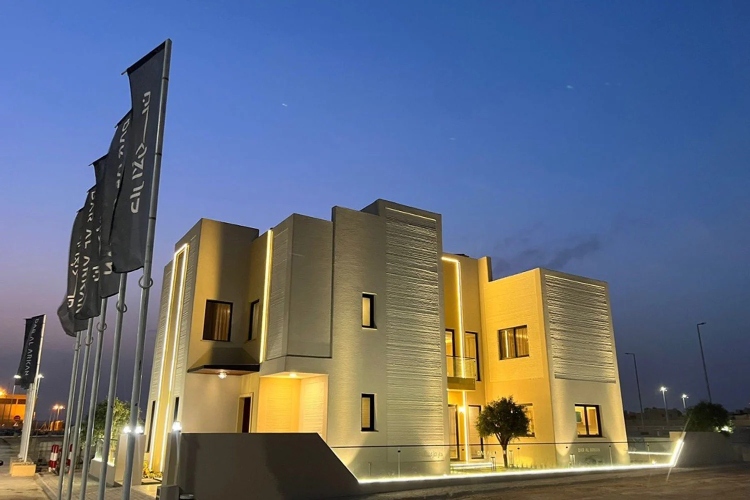
3D printing in Saudi Arabia has evolved from experimental projects to a robust component of the national industrial strategy. What began as high-profile demonstration projects (such as villas, small-scale municipal test buildings, and early structural printing trials) has matured into a government-backed initiative and a cluster of private partnerships.
Together, these elements form the backbone of a developing national additive manufacturing an ecosystem that holds promise for various sectors.
3D printing for construction began gaining global traction in 2013, when a team from the University of Southern California printed a small functional structure. The technology captured wider public and industry attention in 2015 with the construction of the first 3D-printed house in China, sparking a wave of rapid development in architectural 3D printing.
This global momentum extended to Saudi Arabia, where projects grew progressively larger and more sophisticated. In late 2022, the kingdom reached a major milestone when Dar Al Arkan completed Shams Al Riyadh, a three-storey, 9.9-meter-tall 3D-printed villa—one of the largest on-site printed buildings globally. The project highlighted both architectural innovation and the practical viability of concrete printing for residential construction.
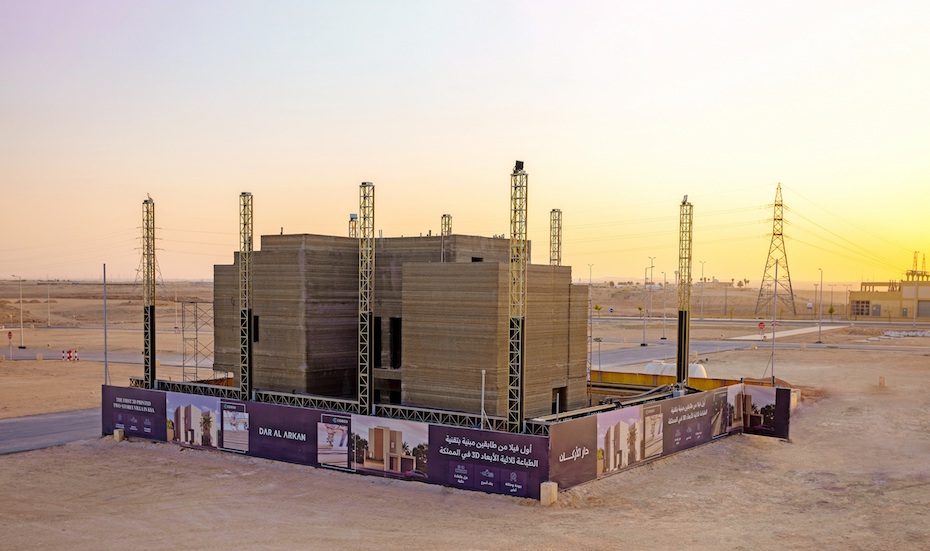
The efficiency demonstrated in constructing two identical 3D-printed pilot villas –each completed in under a month– showcased the technology’s potential to deliver localized, labor-efficient, and low-waste building solutions.
This milestone sets a precedent for future 3D-printed projects within the kingdom and aligns with Vision 2030’s broader goals of innovation and economic modernization.
3D printing quickly expanded from just architecture to important industrial uses and stronger supply chains.
In mid-2024, after several smaller additive-manufacturing setups had already been tested across the kingdom, a major breakthrough occurred when 3D Systems (a Saudi company that specializes in 3D printing technologies and solutions) partnered with the National Additive Manufacturing & Innovation Company (NAMI) to provide advanced metal and polymer additive manufacturing solutions.
The partnership between NAMI and 3D systems is particularly significant for the Saudi Electricity Company (SEC), highlighting how additive manufacturing could reduce lead times for spare parts and diminish the kingdom’s dependency on imports for essential energy-sector components, such as electrical insulator housings, specialized cooling-system, and cable connectors.
Recent announcements from the company Black Buffalo, a U.S. based construction-technology company that develops large-scale 3D concrete printers and materials for building walls, further underscore the growing importance of 3D printing in the construction sector.
In September 2023, Black Buffalo signed a memorandum of understanding with Saudi Readymix, a Saudi Arabian company that manufactures and supplies ready-mixed concrete for construction projects, to introduce code-compliant structural 3D construction inks to the Saudi market.
These inks have enabled the production of durable, code-compliant structural elements tailored for 3D-printed construction. They allow builders in the kingdom to achieve higher quality, faster execution, and reduced material waste.
This initiative represents a critical step towards ensuring that 3D-printed structures adhere to local building codes which is also a necessary consideration as construction methodologies continue to evolve.
As momentum builds in the construction arena, 3D printing is also branching into higher-stakes sectors, such as aerospace and defense.
In September 2025, NAMI announced a strategic partnership with Lockheed Martin, a global aerospace, defense, and advanced technology company headquartered in the United States, aiming to qualify aluminum-based 3D-printed aerospace components in Saudi Arabia.
3D printing holds the potential, if fully adopted, to deliver benefits such as shorter supply chains, on‑demand manufacturing, and increased customization for sectors like construction, healthcare, and aerospace in Saudi Arabia.
Nevertheless, the journey from pilot projects to full-scale industrial adoption is not without its challenges. Several key issues must be discussed to realize the full potential of 3D printing in Saudi Arabia.
Among these are the certification and qualification of safety-critical parts,particularly for applications in aerospace and energy sectors,where rigorous standards must be met to ensure reliability and safety. Additionally, the high costs associated with advanced metal printers and specialized materials present financial hurdles that need to be navigated.
Importantly, workforce development is required to cultivate the skills necessary for design, printing, post-processing, and quality engineering involved in additive manufacturing.
The most credible near-term opportunities for 3D printing in Saudi Arabia are likely to emerge around the production of spare parts for industrial equipment and niche aerospace components. These applications can justify the necessary regulatory investment and technical resources, making them viable candidates for early adoption within Saudi industries.
As Saudi Arabia continues to invest in and develop its 3D printing sector, the nation stands on the brink of a technological revolution that promises to reshape various industries in national hopes that it will contribute significantly to the kingdom’s economic aspirations.

Comments (0)