


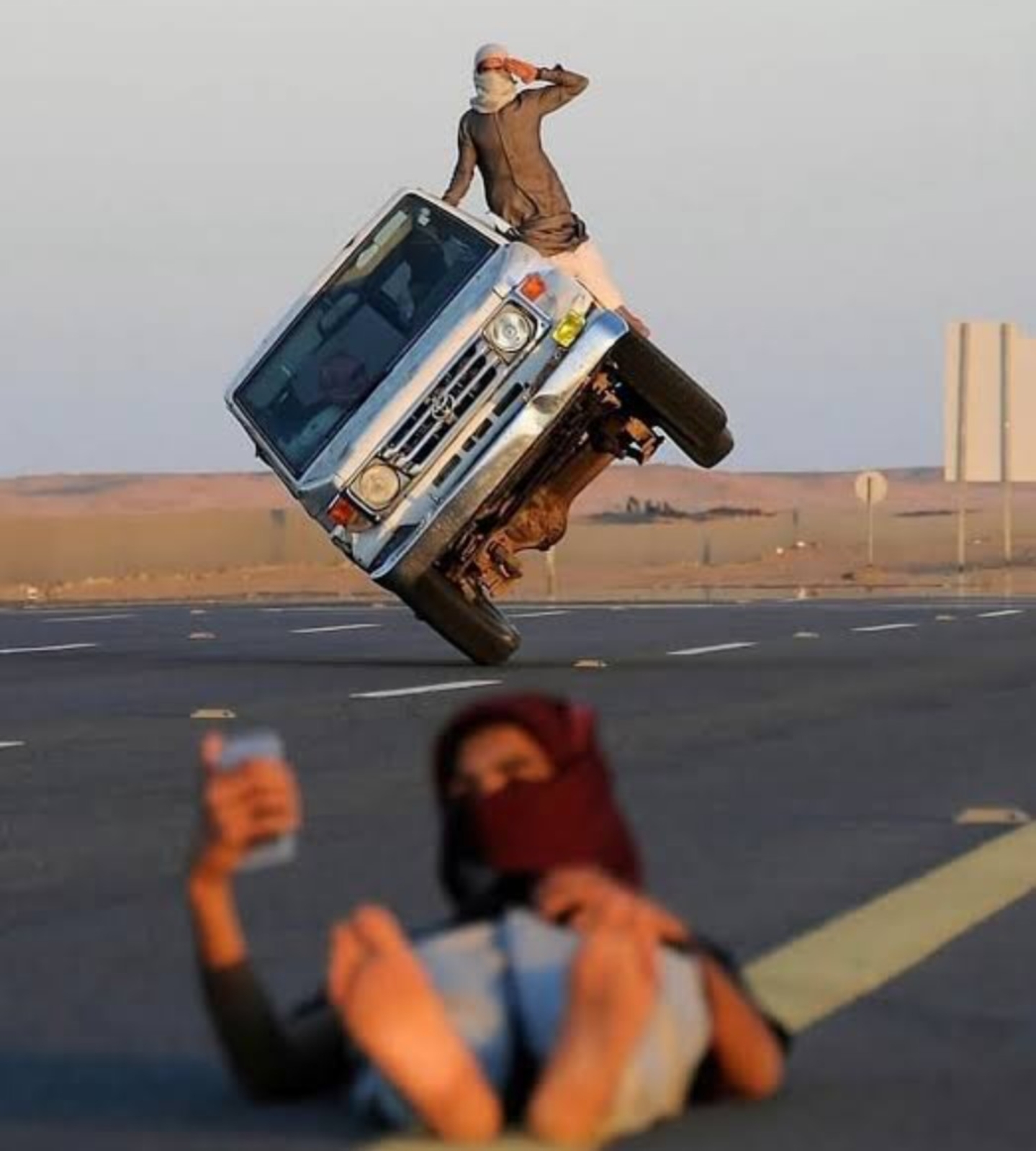
Hajwalah is one of those words that instantly conjures a scene. Empty highways on the outskirts of Riyadh, sodium lights humming overhead, a stock sedan thrown sideways across three lanes of tarmac while a crowd of teenagers screams into their phones.
Long before global motorsport brands arrived in Saudi Arabia, this underground drifting subculture, also known as tafheet, was already rewriting what a car could be and what a road was for.
The birth of a sideways subculture
Hajwalah did not begin with race teams or corporate money. It grew out of a very specific collision of time and place. In the late 1970s and 1980s, the Kingdom built long, straight highways at the same moment that a very young population was coming of age, with cheap petrol, rising car ownership, and very few formal entertainment outlets.
On the fringes of cities such as Riyadh and Qassim, that mix turned into improvised night time rituals. Drivers took ordinary family sedans out to the edges of town and began to experiment. They threw cars into long, sweeping slides, cutting from lane to lane at speeds that could hit 160 or 200 kilometres an hour, while friends hung out of the windows or sat on door sills filming the whole thing. These were not tuned sports cars. They were workhorse Toyotas and Chevrolets pushed so far beyond their intended use that bringing them home in one piece became a mark of skill and luck.
Rules without rulebooks
View this post on Instagram
In Japan, drifting was codified early through circuits, competitions, and judges. Hajwalah grew up in the wild. The highway itself was the arena. There were no marshals, no barriers, no helmets lined up in the paddock.
A typical night might start with messages passed between friends about a particular stretch of road outside the city where traffic thinned out after midnight. Cars gathered on the shoulders, spectators stood frighteningly close to the asphalt, and a chosen driver would launch into a slide that sent the car skating across the full width of the highway. Sirens in the distance could end it at any moment.
The unwritten code revolved around nerve and proximity. Hold the slide for as long as possible. Snap the car straight only when a crash feels seconds away. Skim so near to the crowd that they flinch, but never touch them. Early clips, captured on camcorders and grainy mobile phones, all share the same visual language. Headlights cut through dust. A chorus of shouts pitches up as the car swings around. Sometimes there is the sickening lurch as the frame drops and a vehicle begins to roll.
As camera phones spread in the 2000s, hajwalah leapt from the edge of Riyadh to screens across the Gulf and beyond. Video files moved by Bluetooth and on burned discs, then onto YouTube, where compilations tagged as Arab drifting turned the subculture into a global curiosity. Context dropped away. All that remained were the images of impossible slides and near misses, and with every new upload, the pressure inside the scene rose to go bigger, faster, closer.
Masculinity, monotony and borrowed asphalt
View this post on Instagram
From the outside, hajwalah can look like pure recklessness. Inside the world that produced it, the story is more tangled. In a society that historically offered few shared public spaces and tight rules around how and where young men could spend their time, the car functioned as a kind of portable private room and mobile stage.
For many of its participants, hajwalah was an answer to several different needs at once. It was a test of bravery in a social environment that places a high value on courage. It was a way to gain a name and a following in districts where formal paths to recognition felt limited. And it was a way to hijack infrastructure that had been built for movement and turn it into a backdrop for spectacle. A dead straight stretch of tarmac became a theatre. Streetlights and speed cameras became props. The soundtrack mixed shababi pop, Gulf rap, engine noise and the chant of onlookers as the car came within a metre of their toes.
For all its anarchy, hajwalah demanded real technical ability. Drivers learned how to unsettle a front wheel drive sedan, how to trigger a slide with a sudden steering input or a dab of the brake, how to catch the car before it snapped into a spin. It was a form of hard earned car control, applied in the worst possible environment for mistakes.
The cost and the crackdown
The romance came with a price. The same lack of barriers and safety gear that gave hajwalah its outlaw charge made it brutally unforgiving. Crashes were common and grisly. They did not only affect the drivers who chose to take part. Passengers, friends standing at the roadside and other motorists travelling the same roads were all drawn into the collateral damage when things went wrong.
As accident figures climbed, public pressure mounted. Families who had lost sons, brothers or neighbours began to push back against any suggestion that this was a harmless youth fad. Local media ran stories that turned hajwalah into shorthand for a wider unease about joblessness, boredom and disconnection among some young men.
Authorities responded in phases. Patrols increased around known hotspots. Over time, new traffic rules introduced much tougher penalties for dangerous driving, including heavy fines, possible jail time and the confiscation and auctioning of vehicles used in illegal drifting. The message from the state shifted from uneasy tolerance to open confrontation. What had once been treated by some as chaotic but forgivable behaviour was increasingly framed as a crime with clear victims.
At the same time as hajwalah was coming under pressure, Saudi Arabia was changing in other, deeper ways. The last decade has seen a rapid roll out of formal motorsport and entertainment infrastructure. New circuits, drift parks and drag strips appeared. International series arrived in the Kingdom, from Formula E in Diriyah to Formula 1 in Jeddah.
Some of the energy that once powered highway drifting began to move into these sanctioned spaces. Young drivers who might have tested themselves on the third ring road now had a way to do something similar, legally and with safety protocols, at a track day or a grassroots drift event. The culture around cars split. There was still an underground of street drifting, but it no longer had the same gravitational pull. In parallel, a polished, regulated scene connected to global motorsport and sponsored events rose into view.
Beyond cars, the social map shifted more broadly. Cinemas reopened after decades. Concerts became regular fixtures rather than rare exceptions. Festivals, comedy nights, gallery openings and neighbourhood events filled parts of the calendar that used to feel empty. For many would be drifters, the calculation behind risking a prison term or a fatal crash for a few seconds of clout started to tilt in a different direction.
Memory, myth and what remains
Hajwalah has not vanished entirely. Clips still surface from remote stretches of road and some young drivers continue to chase that old thrill at the margins. Online, older videos circulate as artefacts of a different era, often shared with a mix of nostalgia and disbelief. People who were there talk about it with complicated feelings, somewhere between pride in their nerve and an awareness of how easily it could have ended in disaster.
Its legacy is messy. The subculture glamorised behaviour that shattered lives, and many families still live with that reality. At the same time, the story of hajwalah has forced important questions into the open. It has highlighted what happens when a very young, car centric society grows faster than its social infrastructure. It has exposed how public space is contested after dark, and how quickly a landscape of roads and interchanges can be remade by people who feel they have nowhere else to go.
Today, the official narrative of Saudi car culture is written in very different terms. It is told through classic rallies in AlUla, professional drift championships, responsible driving campaigns and slick international races framed by fireworks and grandstands.
Yet underneath that, the memory of hajwalah still runs along the old highways. Before the sponsorship logos and the FIA regulations, the Kingdom’s first real drift culture was carved into its own asphalt, sideways, at three in the morning, with no safety net except skill, luck and the hope that the road would be empty when the car broke traction.

Comments (0)