


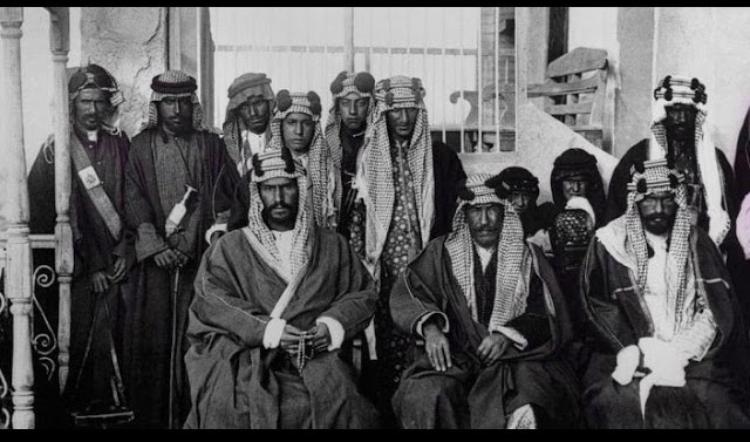
Before 1932, the Arabian Peninsula was not a unified political entity but rather a collection of tribal territories, emirates, and kingdoms. It prominently included Najd in central Arabia), Hejaz in western Arabia, which included Mecca and Medina, and various smaller regions like Asir, Jazan, and Najran.
The influence of the Ottoman Empire still lingered until World War I, but its authority rapidly diminished in the early 20th century, setting the stage for regional shifts in power.
The path to unification began on 15 January 1902, when Abdulaziz bin Abdulrahman Al Saud, who would later become King Abdulaziz, recaptured Riyadh from the rival Emirate of Jabal Shammar and the Rashidi dynasty.
This act restored the family’s ancestral capital and symbolized the beginning of a broader unification campaign. It also marked Abdulaziz’s emergence as a leader rallying various tribes and local forces under the House of Saud, setting the groundwork for what historians call the “Third Saudi State”.
Following the reclaim of Riyadh, Abdulaziz focused on solidifying his influence across the Arabian Peninsula. His strategy combined military campaigns with strategic alliances, enabling him to expand his territory effectively. He strengthened his power base in Najd, relying on tribal alliances and stabilizing the region.
Abdulaziz’s early military campaigns included victories against rival tribal factions, such as the Battle of Dilam on 27 January 1903, which expanded nearby territories and weakened the resistance from the Rashidis.
By 1913, Abdulaziz had successfully captured the eastern provinces of Al-Hasa and Al-Qatif, previously under Ottoman control.
As the unification campaign continued, the Hejaz region emerged as a critical target due to its significant religious importance. Home to Islam’s two holiest cities, Mecca and Medina, the Hejaz was ruled by the Hashemite Sharifian dynasty.
In early September 1924, Saudi forces launched an offensive that culminated in the capture of major cities, including Taif, Mecca, and Medina.
By 1925, Abdulaziz successfully secured the port city of Jeddah, effectively ending Hejaz’s independence and bringing it under his authority. After this conquest, he was crowned King of Hejaz at Mecca’s Grand Mosque on 8 January 1926.
In the aftermath of the Hejaz conquest, Abdulaziz established the Kingdom of Hejaz and Nejd, maintaining separate administrative centers for the two regions: Mecca for Hejaz and Riyadh for Nejd.
Moreover, in 1927, the Treaty of Jeddah was signed with the United Kingdom, formally recognizing Abdulaziz’s sovereignty over Hejaz and Nejd.
Then the formal establishment of the unified Kingdom of Saudi Arabia took place on 19 September 1932, when Abdulaziz issued Royal Decree No. 2716.
The decree specified that, effective 23 September 1932, the unified country would be renamed the Kingdom of Saudi Arabia, marking Abdulaziz’s transition to King of Saudi Arabia.
Even after 1932, King Abdulaziz continued to work toward the integration of southern regions, such as Jazan, which was fully administered by Abdulaziz’s government by 1930.
Additionally, this unification helped forge a shared Saudi identity under the House of Saud, laying the groundwork for future state-building efforts, including socio-political reforms and modernization initiatives.
By consolidating diverse territories, King Abdulaziz solidified a shared national identity that resonates in contemporary Saudi Arabia. The legacy of this unification continues to influence the country’s governance and national pride, as reflected in the annual celebrations of Saudi National Day.

Comments (0)