


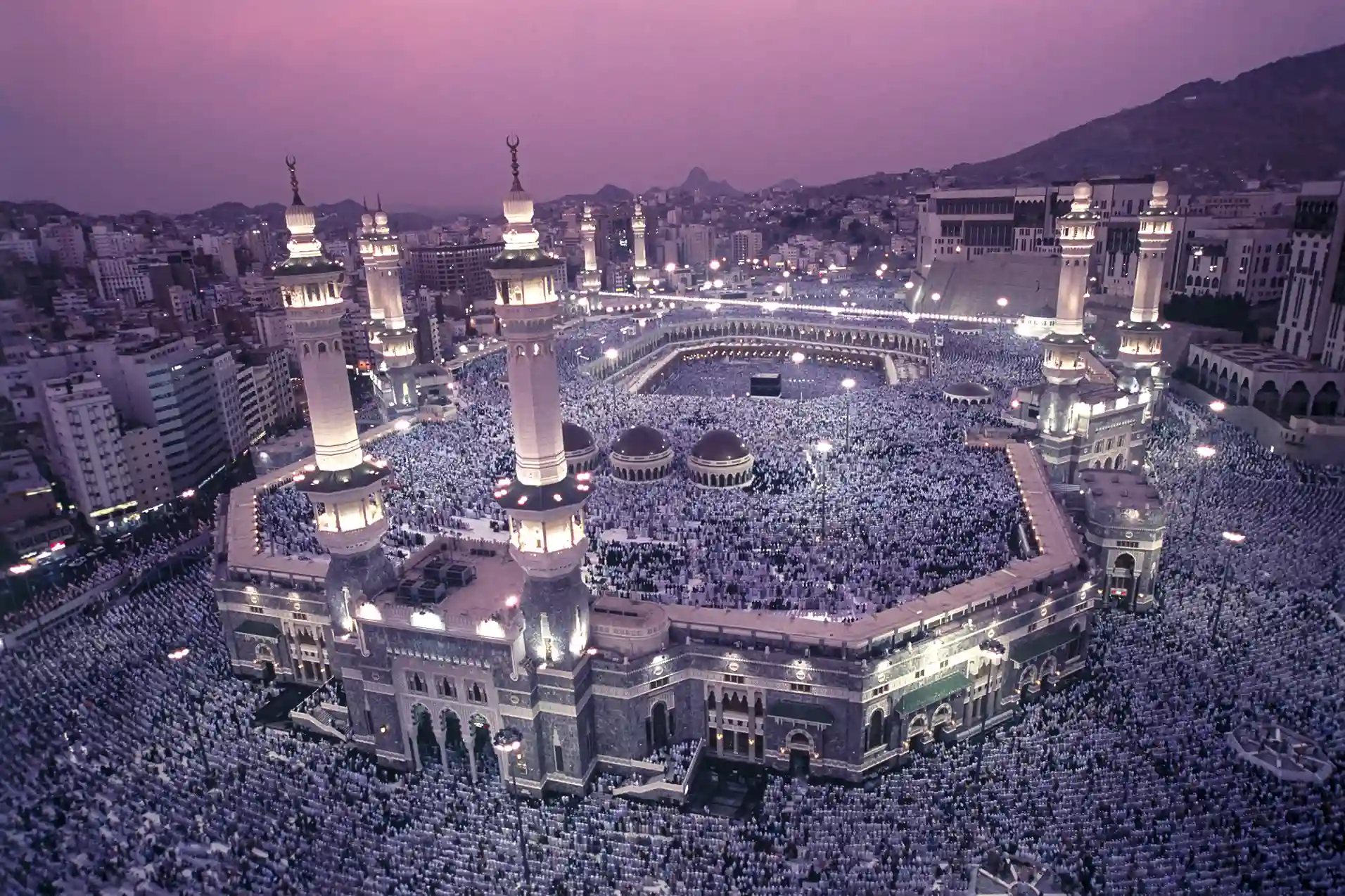
For as long as international pilgrims have been travelling to Mecca (Makkah) by air, they have arrived in the wrong city. King Abdulaziz International Airport sits in Jeddah, roughly 80 to 90 kilometres from Islam’s holiest city. For decades, every pilgrim arriving by plane has faced the same final stretch: a road journey through traffic that, during peak Hajj and Umrah seasons, can stretch from a manageable drive into an hours-long ordeal. Millions of people, many elderly, many travelling for the first and only time in their lives, completing one of Islam’s five pillars while exhausted from a long-haul flight and sitting in a bus queue.
Saudi Arabia has now approved plans to end that. Mecca will get its own international airport. It will also get a metro system. The announcements, confirmed by Saleh Al-Rasheed, CEO of the Royal Commission for Makkah City and the Holy Sites, represent the most significant change to the physical experience of arriving in Mecca since commercial aviation began.
Why There Was Never an Airport Before
The absence of an airport in Mecca was not an oversight. It was a geography problem. The city sits in the Hejaz mountains, surrounded by peaks and narrow valleys that have historically made aviation planners nervous. The terrain creates unpredictable wind patterns, limits approach corridors, and presents landing challenges that kept serious airport development off the table for most of the modern era.
The city’s religious status added a further layer of complexity. Mecca is closed to non-Muslims, which raises questions about how a functioning international airport handles crew layovers, technical staff, and the various categories of non-Muslim aviation personnel who typically move through any airport facility. These questions have not yet been answered publicly, but they will need to be resolved as the project moves from feasibility into detailed design.
What changed is technology and ambition. Aviation engineering has advanced significantly, and Saudi Arabia’s infrastructure programme over the past decade has demonstrated a willingness to solve problems that previous generations of planners deferred. The strategic and economic directions for the airport have been formally approved. The Royal Commission will work with the private sector to develop investment models, with an explicit commitment not to undermine the commercial viability of Jeddah’s King Abdulaziz International Airport in the process.
What the Metro Means
The metro announcement is arguably more immediately consequential than the airport, because it addresses a problem that exists right now, every Hajj season, for millions of people.
Mecca already has a metro line of sorts: the Mashair Railway, a dedicated Hajj-season service connecting the Grand Mosque to the holy sites of Mina, Muzdalifah, and Arafat, the three locations central to the Hajj rituals. It operates only during the Hajj period and carries enormous numbers of pilgrims through the ritual sequence. It is not a city metro in any conventional sense.
What has now been approved is something different: a full urban metro network for the city, with feasibility studies and preliminary designs completed and submitted to the relevant authorities. The system would connect the Grand Mosque to accommodation districts, transport hubs, the holy sites, and eventually the new airport. For the elderly pilgrim navigating a city of millions in summer heat, or the Umrah visitor trying to move between the Grand Mosque and their hotel multiple times a day, a functioning metro is not a luxury. It is the difference between a pilgrimage that is spiritually and physically manageable and one that is simply exhausting.
The existing Haramain High-Speed Railway already connects Mecca to Jeddah and Medina, a significant piece of infrastructure completed in 2018 that cut the Jeddah to Mecca journey to roughly 45 minutes by train. The new metro would extend that connectivity inward, creating a transport network that allows a pilgrim to move from international arrival to the Grand Mosque with minimal friction.
Smart Mecca and the AI Crowd Question
Running alongside the airport and metro announcements is a broader digital transformation initiative that Al-Rasheed has described as “Smart Makkah.” The programme uses artificial intelligence to monitor and manage crowd movement in and around the Grand Mosque, a challenge that is unlike any other crowd management problem on earth.
During peak Hajj, Mecca receives more than 1.5 million foreign pilgrims, alongside a significant number of domestic Saudi pilgrims. The Jamarat Bridge, where pilgrims perform the ritual stoning of the devil, has historically been one of the most dangerous crowd scenarios in the world, with fatal crushes occurring in 1994, 1998, 2001, 2003, 2004, and most catastrophically in 2015, when more than 2,000 pilgrims died in a stampede. The bridge has been rebuilt and widened since, but crowd management remains the single most critical operational challenge of Hajj.
The Smart Mecca programme deploys predictive systems for crowd flow at the Jamarat Bridge and central zones, combined with aerial imaging integrated with the Balady government application, giving authorities real-time visibility of where pressure is building before it becomes dangerous. A new Mecca Taxi service with GPS-tracked vehicles and electronic payment options is also being rolled out, alongside an expanded bus network that already carries 400 buses across 12 routes serving more than 430 stops.
The Scale of What Is Being Built
The infrastructure announcements sit within a broader development programme for Mecca and its surrounding holy sites that is substantial in scale. Eight sites in Arafat covering around 190,000 square metres are being upgraded, including two-storey tent structures over 33,000 square metres for pilgrims. Ten residential towers with capacity for 27,000 pilgrims are under development. A 200-bed emergency hospital is being built in Mina. Shaded and cooled walkways covering more than 285,000 square metres are being constructed across the city. Twenty thousand trees are being planted as part of a sustainability programme, with integrated waste management delivering savings of over SR310 million.
The West Jamarat station is being developed to allow the Tawaf Al-Ifadah, one of Hajj’s central rituals, to be completed within 20 minutes, with a capacity of 20,000 passengers per hour.
These are not modest numbers. They reflect a comprehensive redesign of Mecca’s infrastructure for a future in which Hajj capacity continues to grow, Umrah visitation expands year-round, and a city of profound global significance is asked to function at a scale that has no historical precedent.
What Comes Next
The airport and metro remain at approval and feasibility stage. Detailed designs, investment structures, contractor procurement, and construction timelines have not been publicly confirmed. The airport in particular faces a complex set of engineering, religious, and operational questions that will take years to resolve. Saudi Arabia has demonstrated across its infrastructure programme that it is capable of building at extraordinary speed when the political and financial commitment is in place. Whether the same pace applies here will become clear as the projects move from announcement into planning.
What is already clear is the direction. Mecca, for most of its modern history as a pilgrimage destination, has been a city that the world could only reach indirectly. The decision to build it a direct gateway is a statement about how Saudi Arabia sees the future of the world’s most visited holy city, and about the ambition behind Vision 2030’s promise to transform the Hajj and Umrah sector into a pillar of the Kingdom’s post-oil economy.
For the millions of pilgrims who will make that journey in the years ahead, it may simply mean arriving without the bus.


Comments (0)