


Most people, when they think about aging, think about how long they will live. Saudi Arabia is investing a billion dollars a year to change the question. Founded in 2021 and headquartered in Riyadh, the Hevolution Foundation has quietly become one of the largest scientific funders in the world targeting a single problem: how to extend the years of life that humans spend in good health, rather than simply the years they spend alive. The distinction matters more than it sounds, and the science behind it is at the frontier of what modern medicine is attempting to do.
The foundation, chaired by Crown Prince Mohammed bin Salman, operates with an annual budget of up to one billion US dollars. For context, the division of the US National Institute on Aging that supports basic research on the biology of aging spends roughly $325 million a year. Hevolution is, by most reasonable measures, the world’s second-largest geroscience funder. It is structured as a non-profit, with operations in Riyadh and a North American hub in Boston, and it has committed more than $250 million in research grants since its inception, alongside a growing portfolio of direct investments in biotech companies developing the actual therapies.
Shortly after launch, four of those companies have already crossed a critical threshold. They have moved from animal trials to human testing, an achievement that the foundation’s CEO Dr. Mehmood Khan has described as unusual in a sector where most biotech investments fail before they reach this stage. Among them is a programme targeting a potential world-first cure for hepatitis B, a disease that chronically infects more than 250 million people globally and is the leading cause of liver cancer.
The Healthspan Idea
The intellectual core of Hevolution’s work is the distinction between lifespan and healthspan. Lifespan is the total number of years a person lives. Healthspan is the number of years they live without significant chronic disease or disability. Over the past seventy years, global life expectancy has increased by roughly three decades, an extraordinary achievement of public health and medicine. Healthspan has not kept pace. The result is a generation of people who are living longer with diabetes, with cancer, with cardiovascular disease, with dementia, accumulating years in conditions that profoundly reduce quality of life and consume enormous healthcare resources.
The premise behind Hevolution’s investment thesis is that aging itself, rather than the diseases that follow from it, is the underlying process worth targeting. This is known in the field as the geroscience hypothesis: that certain drugs, by altering basic aging processes inside cells, may be able to delay the onset of many diseases simultaneously, including cancer, Alzheimer’s, and cardiovascular conditions. If that hypothesis proves correct, the implications for global healthcare are difficult to overstate. A single therapy that delays the biological aging clock by even a few years would do more for human welfare than treating any single age-related disease individually.
This is the bet Saudi Arabia is making.
The Portfolio That Reached the Clinic
The four companies now in human trials represent very different scientific approaches, which is itself a feature of how Hevolution has chosen to invest. Aeovian Pharmaceuticals, based in California, received Hevolution’s first life sciences impact investment in 2024: a $20 million contribution to a $50 million Series A extension. Aeovian is developing selective inhibitors of mTORC1, a cellular signalling pathway that regulates growth and metabolism and has been implicated in a range of age-related conditions. The company is initially targeting TSC refractory epilepsy and neurological diseases, with potential applications across a much wider set of conditions tied to mTORC1 dysregulation. Hevolution’s Chief Investment Officer, Dr. William Greene, sits on its board.
Vandria SA, headquartered in Lausanne, is developing mitophagy inducers, compounds that prompt cells to clear out damaged mitochondria, the energy-producing organelles whose dysfunction is increasingly understood as a driver of aging itself. Hevolution joined Vandria’s Series A alongside Dolby Family Ventures and ND Capital, and the company’s lead compound, VNA-318, is moving through clinical trials with potential applications in cognitive impairment, Alzheimer’s, Parkinson’s, and other forms of dementia.
Tune Therapeutics, into which Hevolution invested as part of a $175 million Series B, is developing an epigenetic editing platform with applications including a potential hepatitis B cure. The company’s approach involves silencing the viral DNA that integrates into the host genome, an attack on the disease’s persistence mechanism that no existing therapy has achieved.
Rubedo Life Sciences, the fourth company in the cohort, is working on senescent cell-targeting therapies, including treatments for psoriasis that draw on senolytics, drugs that selectively remove the worn-out, inflammation-producing cells that accumulate with age and contribute to a range of chronic conditions.
Each of these companies represents a different theory of how to intervene in the aging process. Hevolution’s portfolio strategy reflects a deliberate decision not to bet on a single mechanism but to fund the most promising approaches across multiple scientific fronts simultaneously.
A Saudi Scientific Story
Hevolution operates internationally, with a Boston hub and partnerships across North America, Europe, and the United Kingdom. Its research grants flow to the Buck Institute in California, the American Federation for Aging Research, and a network of academic laboratories. The TAME Trial, the most closely watched clinical study in the geroscience field testing whether the diabetes drug metformin can slow aging, counts Hevolution among its funders.
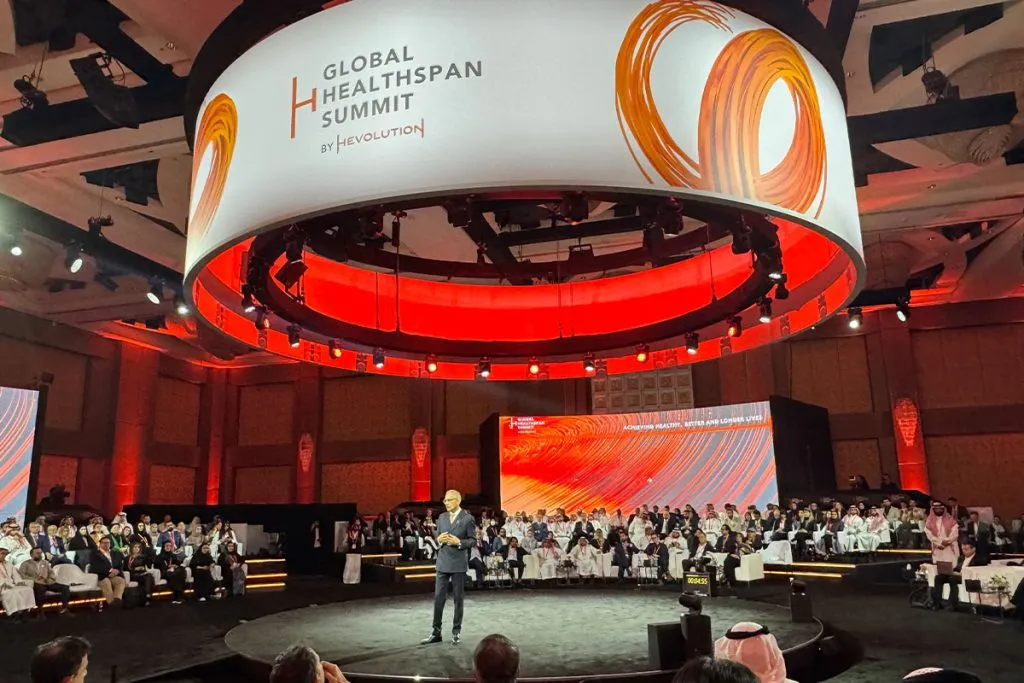
But the foundation’s headquarters, its leadership, and the strategic intent behind it are unmistakably Saudi. The annual Global Healthspan Summit, the world’s largest convening of researchers, policymakers, and biotech leaders in this field, takes place in Riyadh and has become a fixture on the international scientific calendar. The summit’s 2025 edition, held in February, drew more than 150 speakers from the United States, the United Kingdom, Egypt, Germany, and beyond, and saw Hevolution announce close to $100 million in additional research funding across its two days.
The foundation reports directly to Crown Prince Mohammed bin Salman and includes HRH Princess Haya Bint Khaled Al Saud, who holds a doctorate, as its Vice President. The senior leadership, including CEO Mehmood Khan, brings a combination of Saudi institutional backing and decades of international biotech and pharmaceutical experience. Khan previously held senior research and development roles at PepsiCo and Takeda, and at Hevolution has positioned the foundation as a global non-profit with a uniquely Saudi vantage point on a problem the rest of the world is also trying to solve.
Why a Country Funds Aging Research
The question of why Saudi Arabia, specifically, has made this bet has more than one answer. The first is simple economic logic. Aging populations represent one of the most significant healthcare cost pressures faced by every developed and rapidly developing country on earth, including Saudi Arabia, whose demographic structure will look very different by 2050 than it does today. A therapy that compresses morbidity, that delays the onset of chronic disease until later in life, would generate enormous savings for healthcare systems and enormous welfare gains for individuals. The economic case for healthspan research is among the strongest in modern science.
The second answer is reputational and strategic. Saudi Arabia has spent the past decade attempting to build a knowledge economy alongside its hydrocarbon base, and a billion-dollar non-profit dedicated to one of the most consequential scientific questions of the century is the kind of initiative that positions the Kingdom in conversations it would not otherwise be part of. Boston biotech firms, Swiss pharmaceutical companies, and California academic laboratories are now in regular professional contact with Riyadh because of Hevolution. That kind of network effect compounds over time.
The third answer is the one Hevolution’s leadership has consistently emphasised, and it is straightforwardly humanitarian. The foundation has stated, repeatedly, that its mission is built on the belief that every person has the right to live a longer, healthier life. The framing is universalist, the science is international, and the work is being conducted in collaboration with the best laboratories in the world, almost all of which are located outside Saudi Arabia. The Kingdom is funding a project whose beneficiaries, if the science succeeds, will live in Lagos and São Paulo and Manila as well as in Riyadh.
What Success Would Look Like
The honest answer about Hevolution’s portfolio is that biotech is hard, and most drug candidates fail. The four companies now in human trials represent meaningful progress, but Phase 1 trials are early, and the path from a successful Phase 1 to an approved therapy is long, expensive, and frequently unsuccessful. Even Hevolution’s leadership has framed the foundation’s work in terms of decades rather than years.
What would success look like, in the scenarios where the science does work? A first approved therapy targeting a hallmark of aging rather than a single disease. A regulatory pathway, currently nonexistent, for drugs that extend healthspan as their primary indication. A generation of older adults who experience cardiovascular disease, dementia, and cancer ten or fifteen years later than they would have otherwise. A measurable compression of the period of life spent in chronic illness.
None of this is guaranteed. All of it is more likely now than it was five years ago, in significant part because of the funding Hevolution has put into the field. A billion dollars a year, sustained over decades, changes what kind of science is possible. That is the thesis Saudi Arabia is testing.
The Kingdom that most of the world still associates with oil exports is also, quietly, running the largest non-governmental experiment in human history on whether aging itself can be slowed. The first results are now being read out in clinical trial sites across the world. Whether they succeed or fail will matter, eventually, to everyone alive.
Comments (0)