


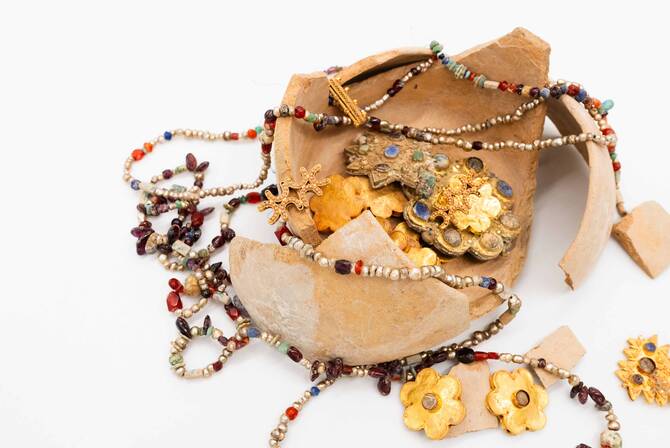
The Saudi Heritage Commission announced on Tuesday, 19 May, the discovery of a collection of 100 gold jewelry pieces dating back to the Abbasid era at the Dariyah archaeological site in Saudi Arabia’s Al-Qassim Region.
The collection, believed to have once formed a complete jewelry set, includes gold pieces shaped like flowers, colorful beads, and ornaments decorated with embedded stones. Among the discoveries was a large circular piece featuring symmetrical stone patterns set within gold frames.
According to the commission, they were found at the Dariyah archaeological site as part of the fourth season of the commission’s archaeological survey and excavation project, alongside the remains of stone buildings, mud walls, hearths, plastered rooms, pottery, and metal tools dating back to the Abbasid period.
Archaeologists said the jewelry was made using techniques such as hammering and hand-shaping gold sheets, reflecting the sophisticated craftsmanship and decorative styles of the period, which ruled much of the Islamic world between 750 and 1258 CE.
According to Arab News, Jasir Suliman Alherbish said the discovery adds to understanding the Kingdom’s historical and cultural heritage.
The findings also shed light on the historical importance of Dariyah, which was once located along major trade and pilgrimage routes, including the Basran Hajj route connecting Iraq to the Arabian Peninsula.
Located southwest of Al-Qassim, the site contains archaeological remains dating from the pre-Islamic period through the early Islamic era, highlighting centuries of human settlement and movement through the region.





Comments (0)