
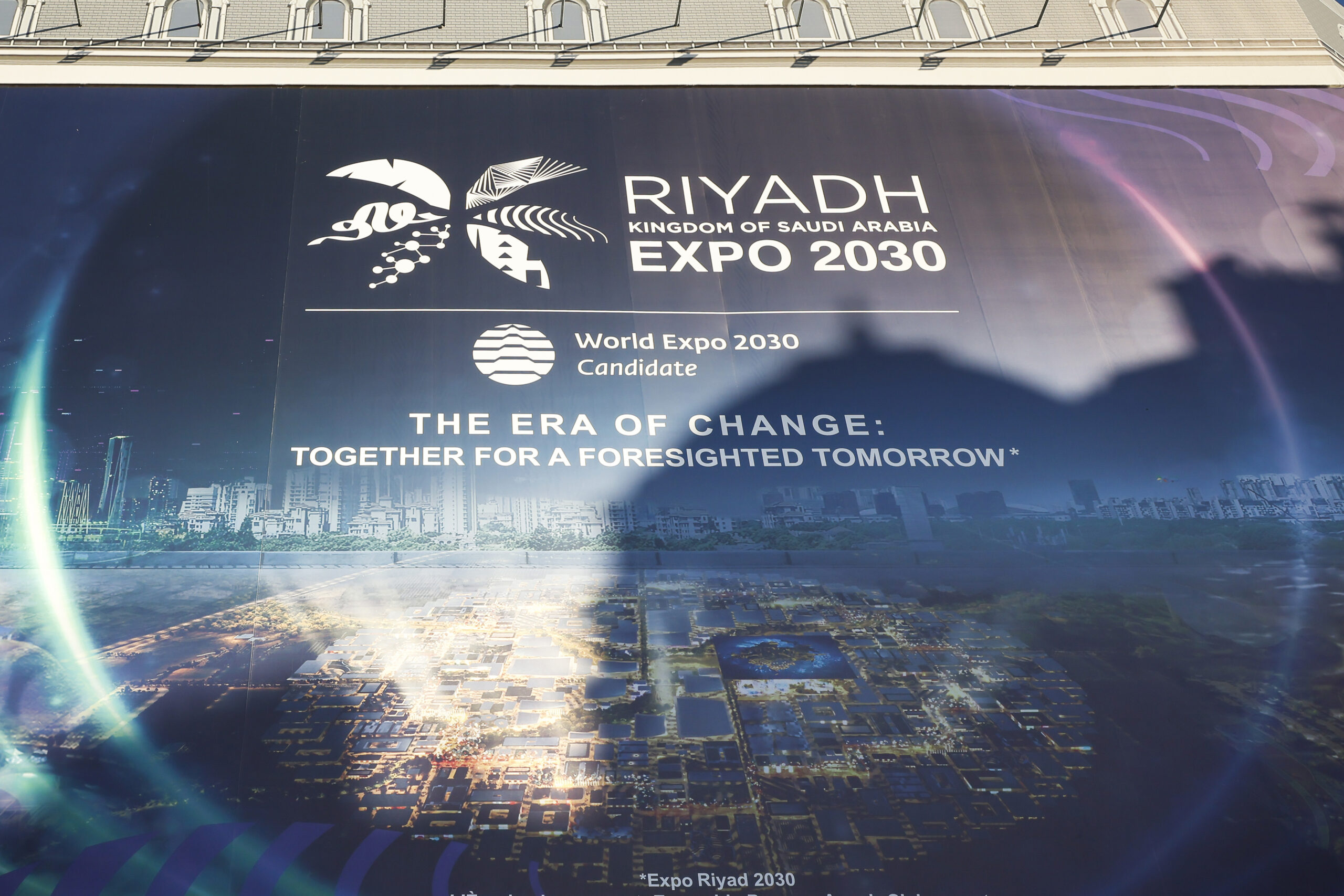
In November 2023, in a conference hall in Paris, delegates from 182 countries cast secret ballots to decide which city would host the World Expo in 2030. Riyadh won on the first round of voting, taking 119 of the votes against Rome and Busan, a margin decisive enough to settle the contest immediately. For Saudi Arabia, it was one of the most significant diplomatic and soft-power victories of the entire Vision 2030 era. For the rest of the world, it set in motion the largest event the Kingdom has ever attempted to stage.
Expo 2030 Riyadh will run from October 1, 2030 to March 31, 2031, six months during which Saudi Arabia expects to welcome more than 40 million visits to a purpose-built city on the northern edge of Riyadh. To understand why this matters, it helps to understand what a World Expo actually is, and why countries compete so fiercely to host one.
What a World Expo Is
World Expos are among the oldest and largest international gatherings on earth. The first was held in London in 1851, the Great Exhibition housed in the Crystal Palace, and they have taken place roughly every five years since. They are governed by the Bureau International des Expositions, the Paris-based body that sanctions official Expos and selects host cities through a vote of member states.
These are not trade fairs in any ordinary sense. A World Expo is a six-month global event in which nations build elaborate pavilions to showcase their culture, technology, and vision for the future, all organised around a common theme. The Eiffel Tower was built for the 1889 Paris Expo. The Seattle Space Needle was built for the 1962 Expo. Dubai hosted the most recent edition, Expo 2020, which despite being delayed a year by the pandemic drew more than 24 million visits and transformed a stretch of desert between Dubai and Abu Dhabi into a permanent district. Expos are, in effect, a temporary world’s fair where the entire planet is invited to make its case for the future in one place.
Riyadh will be the second Middle Eastern city to host one, after Dubai. That fact alone says something about how rapidly the centre of gravity for these mega-events has shifted toward the Gulf.
The Theme: Foresight for Tomorrow
Every Expo is built around a theme, and Riyadh’s is “Foresight for Tomorrow.” The framing, rooted explicitly in the language of Vision 2030, asks participating nations to explore how collective imagination, innovation, and collaboration can shape a more resilient and equitable future. It is broad by design, the way Expo themes always are, but it is supported by three more concrete sub-themes that will organise the content: Prosperity for All, Climate Action, and A Different Tomorrow.
The choice of theme is not incidental. Saudi Arabia has spent the past decade attempting to reposition itself in the global imagination as a country oriented toward the future rather than defined by oil, and an Expo built around foresight and tomorrow is an almost literal expression of that ambition. Whether the content delivers on the theme will be judged in 2030. The framing, for now, is consistent with everything else the Kingdom has been signalling about how it wants to be seen.
The Site and the Masterplan
The Expo will be staged on a six million square metre site in North Riyadh, one of the largest footprints in the history of World Expos. The gated event area alone will span around two million square metres, larger than the comparable area at Dubai 2020. The masterplan was developed by LAVA Architects, a practice headquartered in Berlin and Sydney, working with a large international team of engineers and planners led by Buro Happold.
The design concept is striking. The site is organised around an ancient wadi, Wadi Al Sulai, a nod to the geological and historical origins of Riyadh itself, with more than 226 pavilions arranged in a circular layout. An “equator line” runs through the site, intersecting the circular arrangement and symbolising equality and connectivity among the participating nations. At the heart of the plan sits a central landmark built from 195 columns, one for each participating country, housing three pavilions dedicated to the event’s sub-themes.
The whole site is designed around smart infrastructure powered by artificial intelligence, climate-responsive architecture built to green building standards, and clean solar energy, with the stated goal of zero carbon emissions during the event. Crucially, it sits beside the new King Salman International Airport, the vast six-runway airport being built to handle the volume of international arrivals that an Expo demands. A dedicated metro line will connect arriving passengers to the Expo site in roughly ten minutes, with the broader Riyadh Metro network linking the site to the rest of the city.
What to Expect as a Visitor
For the visitor, an Expo is part theme park, part diplomatic showcase, part architectural exhibition. Each participating country builds its own pavilion, and the competition between them to produce the most memorable, most photographed, most talked-about structure is a significant part of the experience. At Dubai 2020, the pavilions ranged from immersive technological spectacles to quiet meditative spaces, and the best of them became destinations in their own right.
Riyadh is targeting 40 to 42 million visits across the six months, alongside an ambitious goal of one billion virtual visits through a metaverse platform, an acknowledgement that a modern Expo is as much a digital event as a physical one. Visitors can expect national pavilions from nearly 200 countries, thematic zones built around the sub-themes, cultural programming and live performance, food from around the world, and the kind of large-scale architectural and technological spectacle that these events are designed to deliver.
For Saudi residents and the millions of regional visitors within easy reach, it will be the largest single cultural event ever held in the country. For international visitors, it will function as a six-month-long invitation to experience Riyadh at a moment when the city is being remade.
The Legacy Question
The hardest problem any Expo host faces is what happens after the six months end. Expo sites have a mixed history. Some have become thriving permanent districts, while others have decayed into expensive abandoned monuments. The cost of building an entire temporary city is enormous, and Saudi Arabia has committed a reported capital expenditure of around 7.8 billion US dollars to the event, before accounting for the broader infrastructure being built around it.
Riyadh’s answer to the legacy problem is built into the masterplan from the start. After the Expo closes, the site is designed to be transformed into what planners are calling the Global Village, a permanent hub for innovation, knowledge exchange, and cultural engagement. Rather than dismantling the site, the intention is to convert it into a lasting piece of urban fabric, with the pavilions and infrastructure repurposed into a functioning district. Whether that vision is realised will depend on execution, and the track record of post-Expo legacy projects globally is a cautionary one. But the plan, at least, has been designed with the afterlife of the site in mind rather than as an afterthought.
What It Means for Saudi Arabia
Expo 2030 sits at the centre of a remarkable cluster of mega-events that Saudi Arabia has committed to hosting in a compressed window. The Asian Winter Games come to NEOM’s Trojena in 2029. Expo 2030 runs through the winter of 2030 into 2031. The FIFA World Cup arrives in 2034. Together they form a sequence of internationally watched, fixed-deadline commitments that are organising an enormous amount of the Kingdom’s infrastructure investment and that function, collectively, as a forcing mechanism for delivery.
The economic logic is straightforward. An Expo generates direct tourism revenue, accelerates infrastructure that the city would want anyway, and creates tens of thousands of jobs across construction, hospitality, and operations. The Riyadh Metro, the new airport, the hotel capacity, and the transport links being built for the Expo are assets the city retains long after the event ends.
The soft-power logic is just as important. Hosting a World Expo places Saudi Arabia in a small club of nations entrusted with one of the planet’s flagship gatherings, and it brings nearly 200 countries to Riyadh to participate on Saudi soil. For a country that was largely closed to international tourism until 2019, convening the world in its capital in 2030 is a statement about how far and how fast it intends to travel.
There are real questions that will follow the project over the next four years. The budget will be scrutinised, the labour conditions on a construction effort of this scale will draw attention, and the regional security environment that has complicated other Saudi events in 2026 introduces a variable that no planner can fully control. These are legitimate considerations, and they will form part of the story between now and 2030.
What is not in doubt is the ambition. Saudi Arabia bid for the right to convene the world in Riyadh, won it decisively, and is now building one of the largest Expo sites in the history of the event to deliver on it. In October 2030, the world will arrive to see what the Kingdom has made. The four years between now and then will determine what it finds.
Comments (0)