


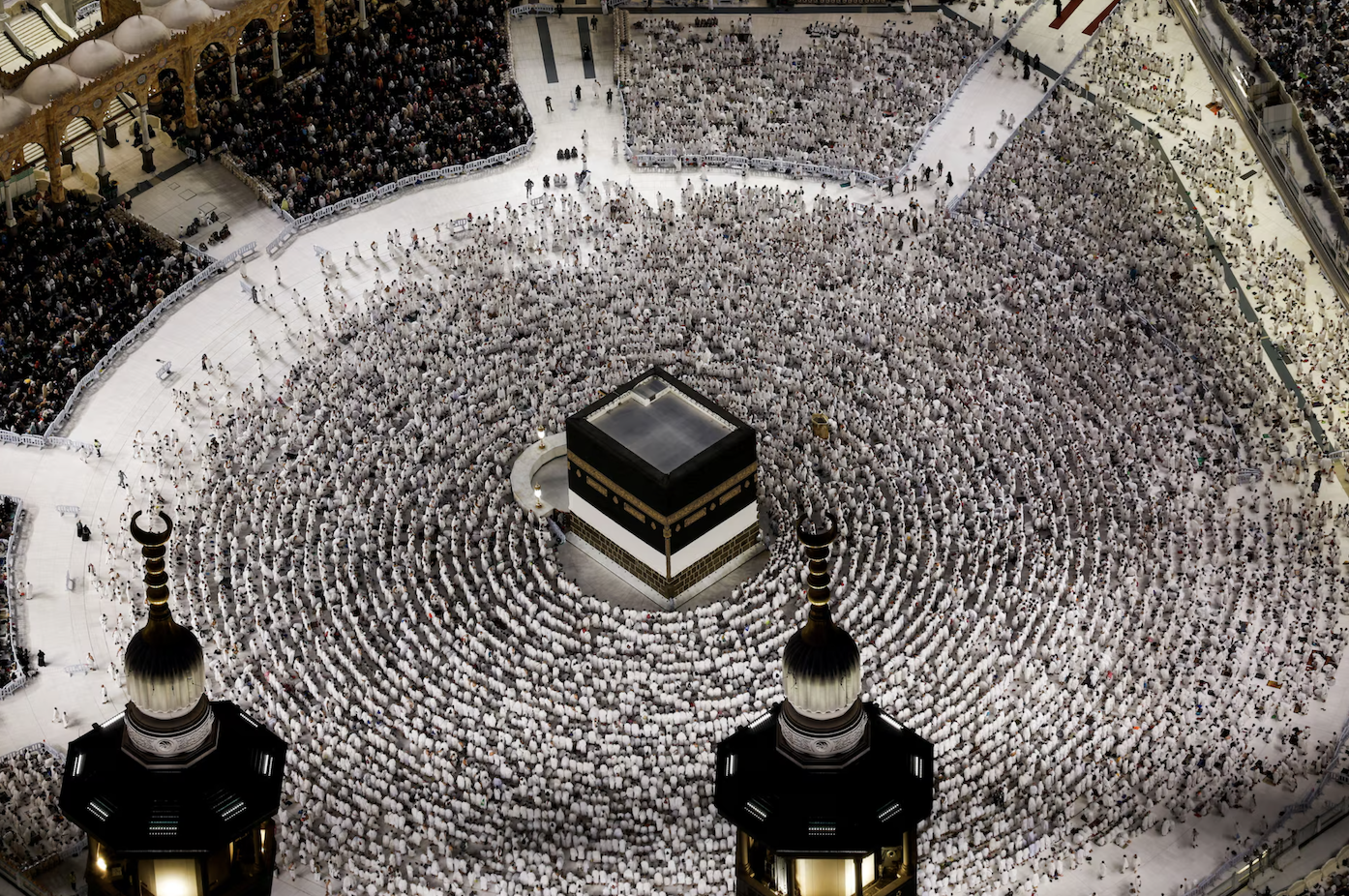
For 1,400 years, the rituals of Hajj have remained unchanged. The circling of the Kaaba in Mecca, the standing at Arafat, the symbolic stoning at Mina, the journey on foot between sacred sites: these are practices that connect every Muslim performing them today directly to the practices of the seventh century. Nothing about the spiritual core of the pilgrimage has been modernised, and nothing about it should be.
What has been modernised, and dramatically so, is the infrastructure that allows 1.7 million people to perform those rituals together in the space of five days without harm. In May 2026, Saudi Arabia concluded what authorities are now calling the first epidemic-free Hajj on record, an extraordinary operational achievement made possible by the most sophisticated deployment of artificial intelligence, drones, biometrics, and autonomous systems ever applied to a single human gathering. The 2026 Hajj was, by any reasonable measure, the largest live test in history of whether frontier technology can be made to serve ancient ritual.
It worked.
The Scale of the Problem
To understand what Saudi Arabia achieved this year, it helps to understand the scale of the problem it was solving. Each year, between 1.5 and 2.5 million pilgrims converge on Mecca and the surrounding holy sites during the brief Hajj window. They arrive from more than 180 countries, speaking dozens of languages, in conditions that this year saw daytime temperatures hit 45 degrees Celsius in Mecca. Many are elderly. Many are travelling internationally for the first time. The vast majority will perform the pilgrimage only once in their lives, and the rituals require them to move in the same direction, at the same time, between the same sites, alongside everyone else doing the same.
The historical record of crowd incidents during Hajj is sobering. The 2015 Mina stampede killed more than 2,000 pilgrims and remains one of the deadliest crowd disasters in modern history. Similar incidents occurred in 1990, 1994, 1998, 2001, 2003, 2004, and 2006. The Jamarat Bridge, where pilgrims perform the ritual stoning, has been rebuilt and widened multiple times. Heat exhaustion, infection outbreaks, and crowd surges have been the persistent operational risks of Hajj for as long as modern statistics have been kept.
The 2026 season ended without a single major crowd incident, without an epidemic outbreak, and with health authorities reporting that over 1.2 million healthcare services were delivered to pilgrims, predominantly preventive. The Ministry of Sports alone deployed 6,348 volunteers across the holy sites. What made the difference, beyond the human effort, was technology.
The AI That Watches Without Being Seen
At the centre of the 2026 operation are two artificial intelligence platforms developed by the Saudi Data and Artificial Intelligence Authority in partnership with the Ministry of Interior. They are called Baseer and Sawaher, Arabic words meaning, roughly, the seer and the watchers.
Both systems work by ingesting live video and surveillance feeds from a network of more than 15,000 cameras distributed across the holy sites, applying computer vision and thermal imaging analytics in real time. Their job is not to identify individuals. It is to measure crowd density at every point of the pilgrimage route, second by second, and to predict where congestion is about to develop before it actually does. When the system identifies a section of corridor where pilgrim flow is building toward a dangerous threshold, it alerts the centralised command centre operating out of the Royal Commission for Mecca and the Holy Sites, which can then redirect movement, open alternative routes, or deploy ground staff to ease the bottleneck.
The technology is invisible to the pilgrim. That is the point. What pilgrims experienced this year was a corridor that flowed smoothly, a gate that opened at the right moment, a path that did not become a crush. What enabled that experience was a layer of artificial intelligence working continuously in the background to manage flow at a scale no human team could possibly process unaided.
Above the sites, drones equipped with high-resolution and thermal cameras provided aerial coverage that complemented the ground network. These drones served three distinct purposes. They monitored crowd density from above, providing perspectives that ground cameras could not capture. They delivered medical supplies to heat-stressed pilgrims at clinics scattered across the route, a logistics function that turned out to be critical during the peak afternoon temperatures. And, in a less publicised role, specialised drones operated by the General Directorate of Civil Defence carried sensors designed to detect chemical and radioactive materials, an additional layer of preventive security at a gathering of this scale and visibility.
The Robots in the Mosques
Inside the Two Holy Mosques themselves, a different kind of technology met pilgrims directly. Manarah 2, a second-generation multilingual artificial intelligence robot, operated as a guidance system for visitors, capable of conversing in multiple languages, answering questions about ritual procedures, providing directional assistance, and connecting pilgrims to human staff when more complex help was required. For pilgrims who do not speak Arabic, encountering a working AI assistant inside the Grand Mosque represented the most direct human-machine interaction of the entire pilgrimage.
Multilingual smart screens, stationed at key gates and corridors, complemented the robots with real-time information for pilgrims who did not have smartphones or who could not navigate them comfortably. This detail matters. A meaningful proportion of Hajj pilgrims come from lower-income countries where smartphone penetration is incomplete, and a digital strategy that depended entirely on apps would have failed precisely the people the system needs most to serve. The combination of robots, screens, and physical signage worked because it provided multiple parallel access points to the same information.
For pilgrims with smartphones, the Nusuk and Tawakkalna platforms provided more than 1,300 digital services during this year’s pilgrimage, including digital permits, navigation assistance, emergency response activation, and access to the broader Hajj logistical infrastructure. The Banan biometric verification device, deployed at border entry points, identified arriving pilgrims and matched them against authorised registries in under 40 seconds, a speed that meaningfully reduced the bottleneck of mass arrivals through Jeddah and Medina.
The Permit System and the Underlying Database
Underpinning everything was an intricate permit and registry system. Saudi Arabia operates a “No Hajj without a permit” framework, designed to prevent the dangerous overcrowding that occurs when unauthorised pilgrims attempt to perform Hajj outside the official quota system. The framework had existed for years. What made 2026 different was the integration of facial recognition systems at controlled entry points with digital permit databases, allowing instant verification at scale.
The combination produced an operational picture in which authorities knew, in close to real time, who was authorised to be where, who was actually present, and where flows of authorised and unauthorised pilgrims were converging. The system is not without ethical questions. Mass biometric surveillance at any scale raises legitimate concerns about how the data is stored, who has access, and what other purposes it might serve. Saudi authorities have framed the systems strictly within the context of Hajj safety, and the 2026 season has provided a working test case of what mass biometric crowd management actually delivers in practice. That test case will inform broader debates about the technology for years to come.
The Metro That Moves Two Million People
Outside the holy sites, the Al-Mashaaer Al-Mugaddassah Metro continued to function as the backbone of pilgrim movement between Mina, Muzdalifah, and Arafat. The fully electric system, operating only during the Hajj season, moved over two million pilgrims across the ritual sequence this year, a logistical achievement that would not be possible at all without dedicated rail infrastructure. The metro is older than the AI systems by more than a decade, but it remains foundational. The most sophisticated crowd prediction algorithms in the world cannot help you if the underlying transport infrastructure cannot physically move people between sites at the required pace.
The metro is itself in the process of being supplemented by a broader urban Mecca metro and a planned international airport for the holy city, both of which were approved by the Saudi government in April 2026 and represent the next phase of pilgrimage infrastructure development. The 2026 season was operated with the existing rail and bus network. By 2030, the picture will have changed significantly again.
Environmental Monitoring at Pilgrim Scale
A less visible but equally important layer of the 2026 operation involved satellite-based AI environmental monitoring. Daily satellite feeds from 31 locations across the holy sites were processed through machine learning systems designed to identify environmental risks, including air quality variations, water system anomalies, and waste accumulation patterns that could foreshadow public health risks if left unmanaged. The system fed alerts to the relevant ministries, allowing intervention before risks became visible to pilgrims themselves.
The integration of satellite environmental monitoring with ground-level crowd management produced a picture of the pilgrimage that no individual human team could have assembled. For the first time, the entire Hajj operation was effectively visible to its operators in close to real time, from the macro level of weather and environmental conditions down to the micro level of individual corridor density at the Jamarat Bridge.
What the Achievement Actually Demonstrates
The first epidemic-free Hajj on record is not a small claim. It is the result of layered systems, sustained investment, and the willingness to apply genuinely frontier technology to a use case where the stakes are measured in human lives. The 2026 season vindicated a strategic bet that Saudi Arabia has been making for more than a decade: that the Hajj could be modernised in its logistics without being altered in its spirit, and that the world’s largest annual religious gathering could become, simultaneously, the world’s largest real-world deployment of crowd management technology.
The implications extend beyond the holy sites. The systems that Saudi Arabia tested at Hajj scale in 2026 will be deployed at Expo 2030 Riyadh, where 40 million visits are expected over six months, and at the 2034 FIFA World Cup, which will bring its own complex crowd management challenges across multiple Saudi cities. The Hajj has, in effect, become an annual proving ground for crowd technology that the rest of the world will eventually study and adopt.
There is something genuinely striking about the contrast at the heart of the modern Hajj. A pilgrim circling the Kaaba in 2026 is performing the same ritual circle that has been performed in the same place since the time of the Prophet Muhammad. Above them, satellites are processing crowd patterns. Around them, AI is predicting where the next bottleneck will form. Beside them, a multilingual robot is offering directions in their native language. The rituals have not changed, and they will not change. Everything else around them has.
For the 1.7 million pilgrims who completed the 2026 Hajj safely, that change is not abstract. It is the difference between performing the pilgrimage of a lifetime and not making it home. The technology, in this case, has done what technology is supposed to do. It has stayed quietly in the background, and it has worked.



Comments (0)